
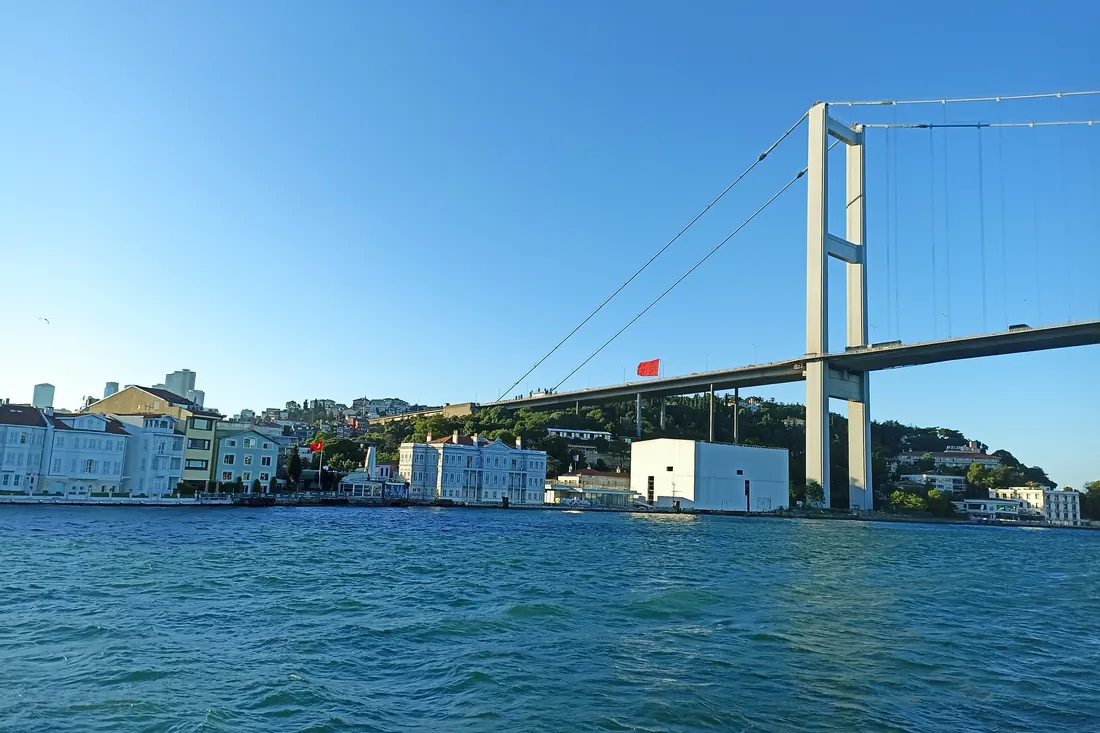
The Istanbul Bosphorus is the narrow strait that splits the city between Europe and Asia and links the Black Sea with the Sea of Marmara. Palaces, Ottoman fortresses, mosques and wooden waterside mansions line both shores, and for most visitors a trip on the water is the highlight of their stay.
This guide covers the main landmarks on the European and Asian shores, the villages worth a stop, the different ways to cruise the strait and the best time of year to go. If you are new to boat trips here, start with our short explainer what a Bosphorus cruise is and how it works.

The Bosphorus at a glance
The strait runs for roughly 30 km from the Golden Horn and the old city in the south to the Black Sea in the north. At its narrowest, between the fortresses of Rumeli Hisari and Anadolu Hisari, the two continents are only about 700 metres apart. Three suspension bridges cross it today, and the Marmaray rail tunnel and the Eurasia road tunnel run beneath it.
Because it is the only sea route between the Black Sea and the Mediterranean, the Bosphorus has been fought over by Greeks, Romans, Byzantines and Ottomans. That history is still visible from the water: almost every bend has a palace, a fortress or a grand yali (waterside mansion). For a map of the main sights, see our Bosphorus Strait landmarks map.
How to see the Bosphorus: cruise options
There is no single best Bosphorus cruise; the right one depends on your time, budget and who you are travelling with. Public ferries, guided day cruises, evening dinner cruises, sunset trips and private yachts all use the same strait. The main options are:
- Shared cruises: daytime sightseeing, sunset and dinner cruises where you share the boat with other travellers.
- Full-day Bosphorus and Black Sea cruise: a longer guided day with lunch that continues to the northern end of the strait.
- Private yacht cruise: a yacht with captain and crew for your group only, on your own schedule.
Our article which Bosphorus cruise to take compares them in more detail, and current schedules for the shared trips are on the Bosphorus cruises page.
Bosphorus dinner cruise with Turkish night show
The evening dinner cruise combines a set Turkish dinner with a stage show while the boat passes the lit-up palaces and bridges. It lasts about 3.5 hours and includes hotel transfers from central Istanbul, which is useful because it finishes late.
The menu usually starts with a welcome drink and a selection of cold mezes, followed by a seasonal salad and a choice of main course (fish, chicken, meatballs or a vegetarian dish), then baklava and fruit. Local drinks are included and imported brands cost extra. The show typically features a whirling dervish performance, folk and Caucasian dances, belly dancers and a DJ.

Bosphorus sunset cruise
A sunset cruise leaves in the early evening so you are on the water as the light turns gold over the old city and the bridges start to glow. Shared sunset cruises serve snacks, fruit and soft drinks, and a guide explains the sights along the way. It is the most photogenic time to be on the strait.


Bosphorus and Black Sea cruise with lunch
If you have a full day, this guided cruise starts on the European side in the morning and sails the whole length of the strait to where it meets the Black Sea. A local guide tells the stories of the buildings on both shores, and lunch is served on the way. It is a relaxed way to escape the city crowds. A shorter half-day version starting around midday is also available; the current programme for every shared cruise is on the Bosphorus cruises page linked above.
Private Bosphorus yacht cruise
On a private cruise the yacht, captain and crew are for your group only, from a couple to 250 guests. You choose the boarding pier, the route, the length of the trip and the menu, so it works well for families, celebrations, birthdays, proposals and company events. Acetes boards from eight piers: Karakoy, Kabatas, Besiktas, Kurucesme, Arnavutkoy, Bebek, Kuleli and Beylerbeyi. You can read the reasons to book a private Bosphorus cruise or ask for a quote on the private Bosphorus yacht cruise page.
Landmarks on the European and Asian shores
Whichever boat you choose, these are the historic sights you will pass. The European shore is on your left as you sail north from the old city, and the Asian shore on your right.
On the European shore
- Topkapi Palace at Sarayburnu, the old city's tip
- Dolmabahce Palace in Besiktas
- Ciragan Palace, now a hotel
- Ortakoy Mosque at the foot of the Bosphorus Bridge
- Rumeli Fortress at the narrowest point
On the Asian shore
- Maiden's Tower off Uskudar
- Beylerbeyi Palace
- Kuleli military school building at Cengelkoy
- Kucuksu Pavilion
- Anadolu Fortress at the mouth of the Goksu stream
Topkapi Palace
Topkapi Palace sits on the Sarayburnu ridge where the Bosphorus, the Golden Horn and the Sea of Marmara meet. It was the residence and seat of government of the Ottoman sultans for around 400 years, and its towers and pavilions are the first big landmark you see from the water. Our Topkapi Palace guide covers a visit on land.

Dolmabahce Palace
Dolmabahce Palace was built for Sultan Abdulmecid, the 31st Ottoman sultan, in a European-influenced style that reflected the empire's push to modernise. Construction began on 13 June 1843 and the palace came into use on 7 June 1856. Its long marble facade is one of the grandest sights on the strait. See our Dolmabahce Palace guide.

Ciragan Palace
The finest stretches of the Bosphorus shore were reserved for the palaces and mansions of sultans and statesmen, and many have since disappeared. Ciragan Palace was rebuilt in stone and marble for Sultan Abdulaziz by architects of the Balyan family, replacing an earlier wooden palace, and was completed in 1871. It burned down in 1910, and the restored building is now a luxury hotel.

Ortakoy
Ortakoy is a waterfront neighbourhood of Besiktas, with its mosque set right on the water beneath the Bosphorus Bridge. It was a favoured spot of the Ottoman elite and today is known for its cafes, weekend stalls and street food. Read more in our Ortakoy guide.

Rumeli Fortress
Rumeli Hisari, the fortress that gives its name to the district in Sariyer, was built by Sultan Mehmed II in 1452, just before the conquest of Constantinople, to control traffic from the north. It stands directly opposite Anadolu Hisari on the Asian shore, and its walls give one of the best views of the strait. See our Rumeli Fortress guide.

Maiden's Tower
The Maiden's Tower stands on a tiny islet off Uskudar and appears in almost every photo of the Bosphorus. In earlier times it was known by names such as Damalis and Leandros, and many legends of love are attached to it. It reopened in 2023 after a long restoration. Our Maiden's Tower guide tells its story.

Beylerbeyi Palace
Beylerbeyi Palace was built on the Asian shore for Sultan Abdulaziz as a summer residence and as a guesthouse for visiting heads of state. Its white facade and seaside pavilions sit just north of the Bosphorus Bridge. Find out more in our Beylerbeyi Palace guide.

Kuleli Military School
The long building with twin towers at Cengelkoy is the historic Kuleli military school. In Byzantine times the site was a grove with a monastery and a tower, which is where the name Kuleli ("with a tower") comes from.

Kucuksu Pavilion
Settlement in this green corner of the Asian shore goes back to the Byzantine period. Under the Ottomans the area was one of the sultans' private gardens, and Sultan Murad IV (1623-1640) is said to have loved it. The ornate pavilion you see today was built in the 1850s as a small summer palace for short stays on the water.

Anadolu Fortress
Anadolu Hisari stands where the Goksu stream flows into the Bosphorus. It was built by Sultan Bayezid I in the 1390s as part of an early Ottoman attempt to besiege Constantinople, more than half a century before Rumeli Fortress was built opposite it.

Bosphorus villages worth a stop
Between the landmarks are old fishing villages that are now some of the most pleasant neighbourhoods in Istanbul. They are good places for a walk, a fish lunch or a tea by the water.
- Arnavutkoy: wooden houses along the shore road and seafood restaurants.
- Bebek: a smart bay with cafes, a park and a promenade towards Rumeli Hisari.
- Emirgan and Sariyer: a large park famous for its spring tulips, and fish restaurants further north.
- Kuzguncuk: a quiet, colourful Asian-side village with old churches, a synagogue and a mosque close together.
- Cengelkoy and Kanlica: tea gardens on the water, and Kanlica's well-known yoghurt.
- Anadolu Kavagi: the last village before the Black Sea, below the ruins of Yoros Castle, with fish restaurants by the pier.
Best time to visit the Bosphorus
You can cruise the Bosphorus all year, but spring to early autumn is the most comfortable time. From April to October the weather is usually mild to warm and the open decks are pleasant; in April and May the Judas trees turn the hillsides pink and wisteria covers the old houses.
Late autumn and winter can be windy and cold on the water, and some days are grey. Cruises still run, and a heated indoor saloon makes a winter trip enjoyable, but bring warm layers. In any season, late afternoon gives the best light for photos.
Things to do along the Bosphorus on land
A cruise shows you the shores, but several places are worth visiting on foot as well:
- Ortakoy: walk the waterfront, have tea or coffee by the sea and try a kumpir (stuffed baked potato) or a waffle.
- Kucuksu Pavilion: the small Ottoman summer palace can be visited inside and has a garden on the water.
- Maiden's Tower: small boats take visitors across from the Uskudar and Salacak side.
- Rumeli Fortress: climb the walls for a panoramic view of the strait and the Fatih Sultan Mehmet Bridge.
- Palaces: Dolmabahce and Beylerbeyi can both be visited; see our guide to palaces in Istanbul.
Entrance fees and opening hours for these sites change, so check the official websites before you go.
Frequently asked questions
How long is the Bosphorus?
The strait is roughly 30 km long, running from the Golden Horn and the Sea of Marmara to the Black Sea. At its narrowest point, between Rumeli Hisari and Anadolu Hisari, it is only about 700 metres wide.
What is the best way to see the Bosphorus?
By boat. Shared cruises are the budget-friendly choice, while a private yacht lets your group choose the pier, route, timing and menu. Spending some time on land in Ortakoy, Bebek or Rumeli Hisari adds a lot to the experience.
How long does a Bosphorus cruise take?
Short sightseeing and sunset cruises last about two to three hours, the dinner cruise about 3.5 hours, and the Bosphorus and Black Sea cruise takes most of the day. Private cruises can be as long or short as you like.
Which side of the boat is best on a Bosphorus cruise?
Both shores have major landmarks, so there is no wrong side. Sailing north, the European shore with Dolmabahce and Rumeli Fortress is on the left and the Asian shore with Beylerbeyi Palace is on the right; most boats turn around, so you see both.
When is the best time of year for a Bosphorus cruise?
April to October usually has the best weather for open decks, and spring brings the Judas tree blossom. Winter cruises run too, but it can be windy and cold on the water.
See the Bosphorus on your own yacht
A private yacht cruise with captain and crew, only for your group: sunset, dinner or a full day on the strait. Book directly with a TURSAB-licensed Istanbul operator.
More from our Istanbul guide
- Guide to Bosphorus Cruises in Istanbul: Types, Piers and RoutesBosphorus and cruises
- The Bosphorus Strait in Istanbul: History, Geography and LandmarksBosphorus and cruises
- Best Bosphorus Cruises in Istanbul: Which One to ChooseBosphorus and cruises
- Bosphorus Dinner Cruises in Istanbul: Which Type to ChooseBosphorus and cruises