
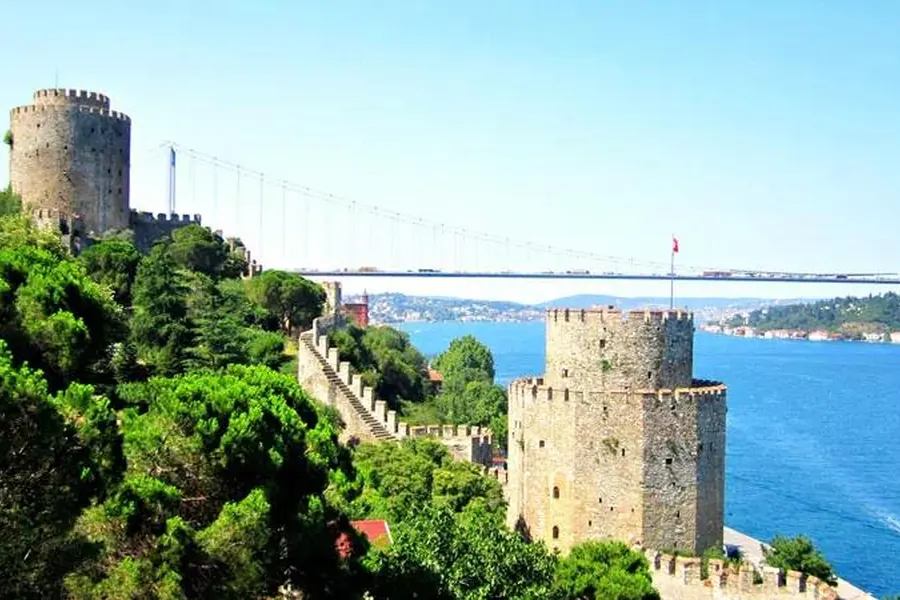
The Bosphorus Strait is the narrow channel of water that runs through the middle of Istanbul, linking the Black Sea with the Sea of Marmara and forming one of the natural boundaries between Europe and Asia. It is an international shipping lane, a commuter route for ferries, and the stage for much of the city's history. Civilisations have settled on its shores for thousands of years, and both banks are still lined with palaces, fortresses, mosques and wooden waterside mansions.

The strait changes with the seasons. In spring the hillsides turn purple with flowering Judas trees (erguvan), usually from late April into May, and in summer the evening breeze off the water makes it the coolest place in the city.
Bosphorus Strait Geography: Length, Width and Currents
The Bosphorus is about 31-32 km long, measured in a straight line from the Black Sea entrance to the point where it meets the Sea of Marmara and the Golden Horn. Its width varies from around 3 km at the northern end to only about 700 m at its narrowest point, between Rumeli Fortress and Anadolu Fortress. The deepest water lies between Bebek on the European shore and Kandilli on the Asian shore.
Two currents flow through the strait at once. Less salty water from the Black Sea runs south along the surface towards the Marmara, while denser, saltier water from the Marmara flows north along the bottom. Together with its tight bends, this makes the Bosphorus one of the more challenging waterways in the world for large ships.
Bridges and tunnels
Three suspension bridges cross the strait: the 15 July Martyrs Bridge (originally the Bosphorus Bridge, opened in 1973 as the first to join the two continents), the Fatih Sultan Mehmet Bridge (1988) and the Yavuz Sultan Selim Bridge near the Black Sea (2016). Beneath the water, the Marmaray rail tunnel and the Eurasia road tunnel also link the two sides.
History of the Bosphorus
The name comes from the ancient Greek Bosporos, usually translated as "ox ford", and is tied to the myth of Io, who was turned into a heifer and swam across the strait. Ancient Byzantium was founded where the strait meets the Golden Horn, and the city later became Constantinople, the capital of the Byzantine Empire, and then Ottoman Istanbul.
Because it is the only sea route between the Black Sea and the Mediterranean, the Bosphorus has always had huge strategic and economic value. Whoever controlled it controlled trade between the Black Sea coasts and the Aegean, the Mediterranean and the oceans beyond. Ships still pass through it day and night, and since 1936 passage has been governed by the Montreux Convention.
The Ottomans tightened their grip on the strait before the conquest of Constantinople. Anadolu Fortress was built on the Asian side in the 1390s, and in 1452 Mehmed II built Rumeli Fortress directly opposite to cut off help reaching the city from the Black Sea. In later centuries the shores became a summer retreat for the Ottoman elite, who built palaces, pavilions and the elegant wooden yali mansions that still line the water.
Landmarks on Both Shores of the Bosphorus
Most of the city's best-known landmarks can be seen from the water. Our full Istanbul Bosphorus guide describes them in more detail.


European shore
- Galata Tower, above Karakoy at the mouth of the strait.
- Dolmabahce Palace, the 19th-century seat of the last sultans.
- Ciragan Palace, now a luxury hotel, between Besiktas and Ortakoy.
- Ortakoy and its waterfront mosque beneath the first bridge.
- Bebek bay and its waterfront villas.
- Rumeli Fortress at the narrowest point of the strait.
Asian shore
- Maiden's Tower on its islet off Uskudar, which reopened in 2023 after restoration.
- Beylerbeyi Palace, a summer palace below the first bridge.
- Kuleli Military High School, with its twin towers in Cengelkoy.
- Anadolu Fortress, opposite Rumeli Fortress.
You will also pass the historic yali mansions of Yenikoy, Kandilli and Vanikoy, and possibly the Savarona, Ataturk's former presidential yacht. Topkapi Palace is visible on the tip of the historic peninsula as you enter or leave the strait.


Things to Do Along the Bosphorus
The area from the Golden Horn to Anadolu Fortress offers plenty to do on land and on the water. Here are the highlights.
Golden Horn and Pierre Loti Hill

Where the strait meets the city, the Golden Horn inlet curves inland. From Eyup a cable car climbs to Pierre Loti Hill, where you can drink tea in the cafe and look down the length of the Golden Horn.
Galata Tower

At around 63 metres, Galata Tower gives one of the best panoramas of the old city and the mouth of the Bosphorus. It is now run as a museum, and the square around its base is a popular place for photos.
Maiden's Tower

The tower on its small island has inspired many legends. Boats take visitors across from the Uskudar shore, and the waterfront opposite is one of the best spots in the city for sunset.
Dolmabahce Palace

The last Ottoman sultans lived in Dolmabahce Palace, and Ataturk spent his final days here. Its halls are filled with crystal chandeliers and lavish furnishings, and the gardens beside the water are calm and green.
Ortakoy

A favourite with Istanbul locals, Ortakoy has a mosque, a church and a synagogue within a short walk of each other, a lively square by the pier, cafes, bars and stalls selling kumpir (stuffed baked potato). It sits right below the European end of the Bosphorus Bridge.
Rumeli Fortress

Rumeli Fortress is one of the most photographed places on the Bosphorus. The neighbourhood around it has fish restaurants and waterside cafes, and the hill above, Hisarustu, offers wide views over the strait.
Beylerbeyi Palace

Used as a summer palace and to host foreign statesmen, Beylerbeyi Palace has a waterside garden and a cafe where you can stop for tea or breakfast.
Seeing the Bosphorus Strait by Boat

A cruise is the easiest way to see the strait, because the palaces and mansions were built to face the water. Options range from public ferries and shared sightseeing boats to dinner cruises with a Turkish night show and a yacht reserved for your own group. To compare them, read which Bosphorus cruise to take in Istanbul.
- Shared cruises: scheduled boats with set routes and times. See our shared Bosphorus cruises, including the evening Turkish night show dinner cruise.
- Private yacht: a yacht with captain and crew for your group only, from a couple to 250 guests, boarding from piers such as Karakoy, Kabatas, Besiktas or Bebek. Ask for a quote on our private Bosphorus yacht cruise page.
Frequently asked questions
How long is the Bosphorus Strait?
The Bosphorus is about 31-32 km long from the Black Sea to the Sea of Marmara. It is roughly 3 km wide at its northern end and only about 700 m wide at its narrowest point, near Rumeli Fortress.
Does the Bosphorus separate Europe and Asia?
Yes. The Bosphorus is one of the boundaries between Europe and Asia, so Istanbul has a European side and an Asian side, linked by three bridges and two tunnels.
What is the narrowest point of the Bosphorus?
The narrowest point is between Rumeli Fortress on the European shore and Anadolu Fortress on the Asian shore, which is why the Ottomans built fortresses there.
What is the best way to see the Bosphorus?
By boat, because most palaces and mansions face the water. You can choose a public ferry, a shared sightseeing or dinner cruise, or a private yacht for your group.
See the Bosphorus on your own yacht
A private yacht cruise with captain and crew, only for your group: sunset, dinner or a full day on the strait. Book directly with a TURSAB-licensed Istanbul operator.
More from our Istanbul guide
- Istanbul Bosphorus Guide: Landmarks, Villages and CruisesBosphorus and cruises
- Ciragan Palace in Istanbul: History and the Bosphorus SettingBosphorus and cruises
- Best Bosphorus Cruises in Istanbul: Which One to ChooseBosphorus and cruises
- Guide to Bosphorus Cruises in Istanbul: Types, Piers and RoutesBosphorus and cruises