
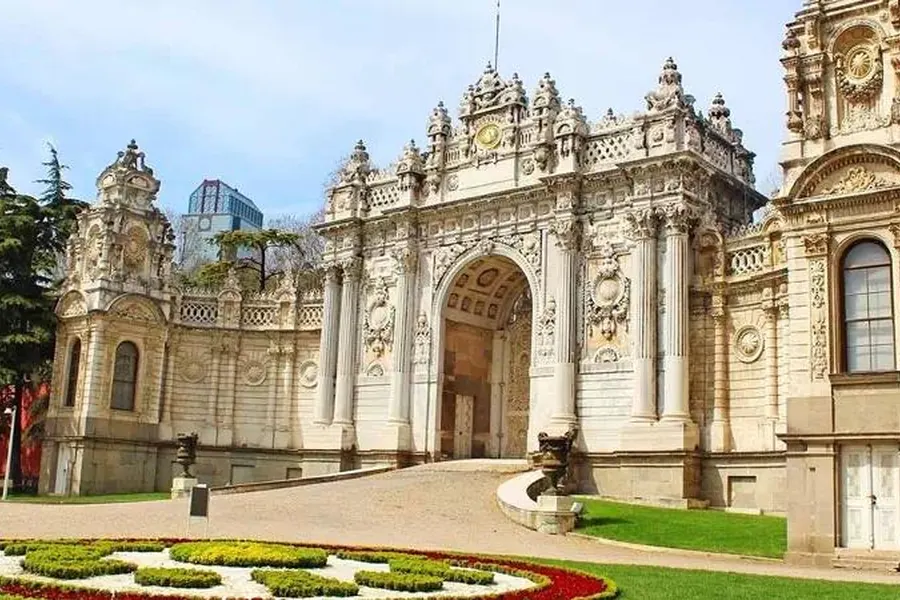
Dolmabahçe Palace stretches for hundreds of metres along the European shore of the Bosphorus, its white marble facade one of the most recognisable sights of Istanbul. Built for Sultan Abdülmecid I and completed in 1856, it brought European architecture and luxury to the Ottoman court, and it is the largest palace in Turkey.
It is also where Mustafa Kemal Atatürk, founder of the Turkish Republic, spent his final days, which gives it a special meaning for Turkish visitors.

History of Dolmabahçe Palace
By the nineteenth century, Topkapı Palace felt old-fashioned to a court that looked increasingly to Europe. Sultan Abdülmecid I commissioned a new palace on land reclaimed from the sea (the name means "filled garden"), designed by the Balyan family of architects. It was completed, together with its surrounding walls, in 1856.
The palace mixes Baroque, Rococo and Neoclassical styles with Ottoman traditions. It covers an area of more than 110,000 square metres and, besides the main building, had sixteen separate sections serving every need of the court: stables, mills, a pharmacy, kitchens, mansions, glasshouses, a foundry and a pastry kitchen. The Dolmabahçe Clock Tower was added later, under Sultan Abdülhamid II (1876-1909).
Six sultans lived here, and after the founding of the Republic Atatürk used the palace during his stays in Istanbul. He died here on 10 November 1938; the clocks in his room were stopped at 9:05, the time of his death.

What to see inside Dolmabahçe Palace
Today the palace is a museum run by the National Palaces administration. Visits are guided or follow a set route through the main sections:
- The Selamlık, the official and ceremonial rooms, with gilded ceilings, crystal staircases and the great Ceremonial Hall under its huge Bohemian crystal chandelier.
- The Harem, the private apartments of the sultan and his family.
- The room where Atatürk died, kept as it was.
- Hand-woven carpets, chandeliers, paintings and the palace collections.
- The palace baths, the Glass Pavilion and the waterfront gardens.
For a wider look at the Ottoman palaces of the city, see our guide to palaces in Istanbul, including Beylerbeyi Palace on the Asian shore and Çırağan Palace further up the European side.
Around the palace
Next to the palace stand the Dolmabahçe Clock Tower, added in the 1890s in the same ornate style, and the Dolmabahçe Mosque, completed shortly before the palace. Both are easy to see on your way in, and the waterfront between Kabataş and Beşiktaş makes a pleasant walk before or after your visit.
Tickets and tips for your visit
Dolmabahçe Palace is run by the National Palaces, not the Ministry of Culture, so the Museum Card is not valid here. Entrance fees and opening hours change often, so check the current details on the official National Palaces website before you visit.
- The palace is closed on at least one weekday, so check the days before you go.
- The number of daily visitors can be limited; arrive early in high season.
- Photography rules inside are strict, and you may be asked to put covers on your shoes.
- Allow two to three hours if you plan to see both the Selamlık and the Harem.
How to get to Dolmabahçe Palace
The palace is in Beşiktaş, a short walk from Kabataş, where the T1 tram and the funicular from Taksim both end. From Sultanahmet, take the T1 tram to Kabataş and walk along the waterfront for about ten minutes.
Seeing the palace from the Bosphorus
The palace was designed to be seen from the water, and its full length is best appreciated from a boat. Our Dolmabahçe Palace tour and Bosphorus cruise combines a visit inside with a cruise, and every private Bosphorus yacht cruise passes in front of its facade.
Frequently asked questions
Who built Dolmabahce Palace?
It was built for Ottoman Sultan Abdülmecid I and completed in 1856, designed by the Balyan family of architects.
Is the Museum Card valid at Dolmabahce Palace?
No. Dolmabahçe is run by the National Palaces administration, so you need a separate ticket.
Why is Dolmabahce Palace important to Turkish people?
Atatürk, the founder of the Turkish Republic, died in the palace on 10 November 1938, and his room is preserved as it was.
How do I get to Dolmabahce Palace?
Take the T1 tram or the funicular from Taksim to Kabataş, then walk along the waterfront to the palace in Beşiktaş.
End your sightseeing day on the water
After the old city, see the palaces and mansions from the Bosphorus on a private sunset yacht cruise, only for your group.