
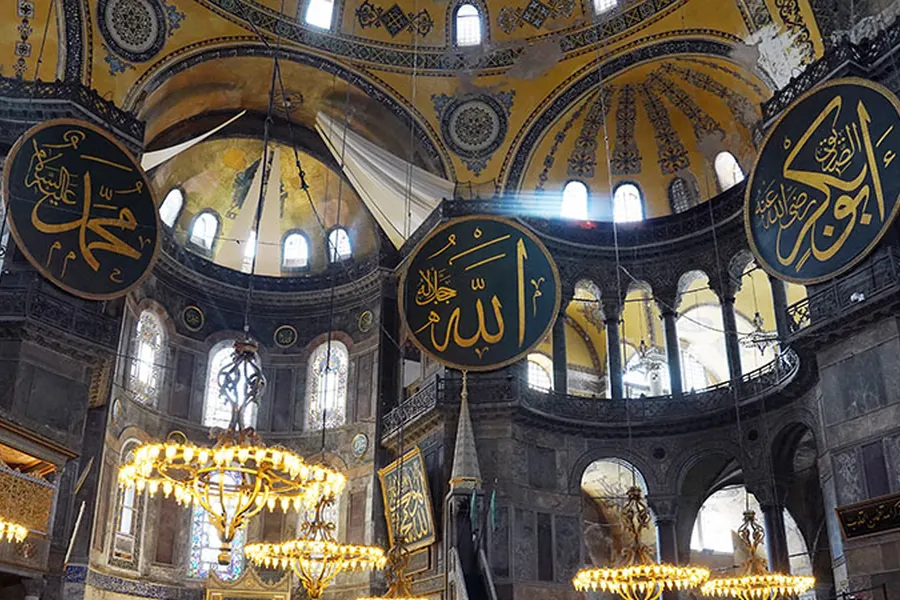
Update 2026: Hagia Sophia has been a mosque again since July 2020. Since 15 January 2024, foreign visitors enter through a separate route to the upper gallery with the Byzantine mosaics, for a fee of €25; the ground floor is reserved for prayer.
Hagia Sophia has stood in Istanbul for almost 1,500 years, first as the great church of Byzantium, then as an Ottoman mosque, a museum and, since 2020, a mosque again. Over that time it has collected countless legends and some genuinely surprising details. These are the secrets of Hagia Sophia: the weeping column, Viking graffiti, hidden mosaics and the stories locals still tell about the building. For opening details and how to visit, see our Hagia Sophia visitor guide.
The Weeping Column (Wishing Column)
In the north-west of the building stands a column with a hole in it, protected by a bronze casing. It is known as the weeping, perspiring or wishing column, and is also associated with St Gregory the Wonderworker. The stone is often slightly damp, and from Byzantine times people believed it had healing powers.
According to legend, Emperor Justinian was wandering through the church with a severe headache. He leaned his head against this column, and after a while the pain was gone. The story spread, and people began to put a finger into the hole and then touch the part of the body that was hurting. Another legend says the moisture is the tears of the Virgin Mary.

The column is on the ground floor. Since 15 January 2024 foreign visitors follow a separate route to the upper gallery for a fee (EUR 25), while the ground floor is reserved for prayer, so you may only be able to see some ground-floor features from above.
Hidden Details in the Upper Galleries
Viking graffiti
On a marble parapet in the upper gallery you can find faint runic letters scratched into the stone. They are usually read as part of the name "Halfdan" and are thought to have been carved by a Norse visitor, possibly a member of the Varangian Guard, the Scandinavian bodyguards of the Byzantine emperors. A second, fainter runic inscription has been found elsewhere in the gallery.
The tomb marker of Enrico Dandolo
In the upper gallery, a simple marble slab in the floor bears the name of Enrico Dandolo, the Doge of Venice who led the Fourth Crusade that captured and plundered Constantinople in 1204. He died in the city in 1205 and was buried in Hagia Sophia. The slab is a later marker; his tomb itself has not survived.
The marble door
Between the sections of the upper gallery stands a marble screen door carved to look like wood. It is sometimes called the "Gate of Heaven and Hell", although the origin of that nickname is unclear. It separated the area used by church officials for synods.
The Mosaics and Their Secrets
Many of the Byzantine mosaics were covered with plaster after the conversion to a mosque in 1453 and were uncovered during restoration work in the 20th century. Several have their own stories.
- The Deësis mosaic: in the upper gallery, Christ is shown between the Virgin Mary and John the Baptist. It dates from the 13th century, probably after the Byzantines recaptured the city in 1261, and is admired for its soft, lifelike faces. Modern rumours that the figure is not Christ but someone else have no basis.
- The Empress Zoe mosaic: Christ sits between Empress Zoe and her husband. Zoe married three times, and the emperor's face and name appear to have been changed to show her latest husband, Constantine IX Monomachos.
- The Komnenos mosaic: Emperor John II Komnenos and Empress Irene flank the Virgin and Child, with their son Alexios on a side pillar.
- The seraphim: four winged figures fill the pendentives below the main dome. Their faces were covered for centuries, and one was uncovered during restoration in 2009. In Islamic tradition they were identified with the four archangels: Gabriel, Michael, Israfil and Azrael.

Ottoman Features and the Direction of Mecca
Hagia Sophia was built as a church facing roughly east, not towards Mecca. When it became a mosque, the mihrab was placed slightly off the central axis to point in the correct direction, which is why the prayer niche and the carpets look a little askew. A folk story says the Archangel Gabriel turned the building towards Mecca with his finger.
Other Ottoman additions are easy to miss:
- The two huge marble urns near the entrance, carved from single blocks and brought from Pergamon under Sultan Murad III.
- The giant calligraphy roundels by Kazasker Mustafa İzzet Efendi, among the largest in the Islamic world.
- The library of Sultan Mahmud I, set behind a bronze grille.
- The omphalion, a square of inlaid coloured marble on the floor where Byzantine emperors are thought to have been crowned.
Legends and Folk Stories
Istanbul's storytellers have attached many legends to the building. They are tales, not history, but they show how much Hagia Sophia means to the city.
The priest who vanished into the wall
When the Ottoman army entered the city in 1453, a priest was celebrating the liturgy. To keep the holy chalice from falling into the soldiers' hands, he walked through a door that turned into a solid wall behind him. The legend says that if the city ever returns to Christian rule, the wall will open and he will finish the service.
The fish that jumped from the pan
During the siege, a monk was frying fish when he was told the city had fallen. He said he would believe it only if the fish jumped out of the pan, and they did. A version of this story is linked to fish figures said to be in Hagia Sophia, although it is better known from the Balıklı spring outside the city walls.
The healing well
A well in the building was said to help people with heart complaints. They would come on three consecutive Saturdays, on an empty stomach after the morning prayer, and drink the water. According to the original story, the well is so deep that a seven-metre pole cannot reach the bottom.
More stories you may hear
- The demon in the stone: after the conquest, Akşemseddin, the spiritual teacher of Mehmed II, is said to have prayed until a demon disturbing the workers was locked inside a stone in the building.
- The holy relics: Hagia Sophia did hold important relics in the Byzantine period, many of them looted in 1204. Legends claim that pieces of the True Cross and the nails of the Crucifixion remain hidden in a secret chamber.
- The coffin that must not be touched: a story says a coffin above one of the doors belongs to a Byzantine empress, and that if anyone touches it, the building will shake.
- The counted doors: a popular tale says the doors of Hagia Sophia can never be counted the same way twice, because there is always one extra.
- Doomsday: another legend says the prophet Khidr (Hızır) wrote the date of the end of the world on a column near the south door.
Seeing Hagia Sophia and Istanbul From the Water
Hagia Sophia and the old city skyline look their best from the sea. On a Sultanahmet tour and sunset cruise you can see Hagia Sophia, the Blue Mosque and the Basilica Cistern with a guide, then watch the sun go down over the Bosphorus. To explore the old city in more depth, join our Istanbul old city tour.
Frequently asked questions
What is the weeping column in Hagia Sophia?
It is a column with a hole covered in bronze, where the stone often feels damp. Legend says it cured Emperor Justinian's headache, so people put a finger in the hole and make a wish.
Is there Viking graffiti in Hagia Sophia?
Yes. Runic letters scratched into a marble parapet in the upper gallery are usually read as the name Halfdan, probably left by a Norse visitor or Varangian guard.
Why is the mihrab in Hagia Sophia off-centre?
The building was built as a church facing roughly east. When it became a mosque, the mihrab was set slightly off-axis so that it points towards Mecca.
Can you still see the mosaics in Hagia Sophia?
Many mosaics, including the Deësis, are in the upper gallery, which foreign visitors reach on a separate paid route. Some figures may be covered or screened during prayer use.
End your sightseeing day on the water
After the old city, see the palaces and mansions from the Bosphorus on a private sunset yacht cruise, only for your group.
More from our Istanbul guide
- Hagia Sophia in Istanbul: History and Visitor GuideIstanbul sights
- Little Hagia Sophia Mosque in Istanbul: History and Visitor GuideIstanbul sights
- Galata Tower in Istanbul: History, Legends and Visitor GuideIstanbul sights
- Aya Irini Church (Hagia Irene) in Istanbul: History and Visitor GuideIstanbul sights