
The Temple of Domitian stands in the upper part of Ephesus, beside the square at the top of Curetes Street, close to the road leading to the Odeon. It was built in the late 1st century AD in honour of the Roman emperor Domitian, who reigned from 81 to 96 AD.
Little of the temple itself is standing today, but its huge terrace and the story of its colossal statue make it an important stop for anyone interested in how Roman cities competed for imperial favour.
History of the Temple of Domitian
The people of Ephesus built this temple to thank Emperor Domitian for the benefits and privileges he gave the city. It was the first temple in Ephesus dedicated to the imperial cult, the worship of the emperor and his family. With it, Ephesus received the honorary title of neokoros, "temple warden" of the imperial cult, which raised its prestige among the cities of the province of Asia.
After Domitian was assassinated in 96 AD, the Roman Senate condemned his memory, and his name was erased from many monuments. In Ephesus the temple was not abandoned but rededicated to his father, Emperor Vespasian.

Rivalry between the cities of Asia
The neokoros title mattered a great deal. The leading cities of the Roman province of Asia, especially Ephesus, Smyrna (today's Izmir) and Pergamon, competed for imperial temples, titles and festivals. Pergamon and Smyrna had already been allowed temples to the imperial cult, so the Temple of Domitian put Ephesus on an equal footing with its rivals. Ephesus later gained further neokoros titles under other emperors.
Architecture and the Colossal Statue
The temple stood on a large artificial terrace supported by vaulted substructures on the sloping ground. The temple itself was surrounded by columns and faced an altar. Its scale was meant to impress anyone arriving in the upper city.
Inside stood a colossal cult statue of the emperor. When Christianity became the dominant religion, the statue was broken up, and only the head and part of an arm are known to have survived. These fragments are now in a museum rather than on site. Scholars still debate whether the head shows Domitian or his brother Titus.
What You See Today
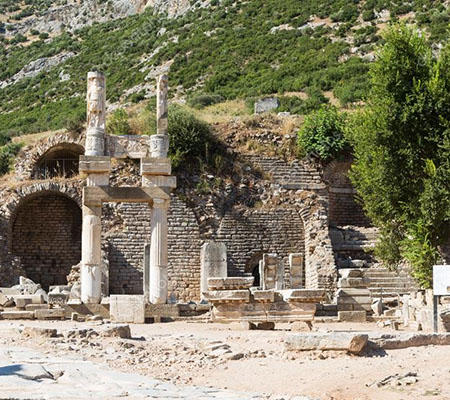
On site you mainly see the platform of the terrace, the vaulted rooms beneath it and scattered architectural pieces. From the edge of the terrace there is a good view over the upper city. Nearby monuments include:
- the Square of Domitian and the Memmius Monument,
- the Pollio Fountain,
- the Odeon and the Prytaneion on the State Agora,
- the start of Curetes Street, which leads down to the Temple of Hadrian and the Library of Celsus.
Tips for Your Visit
- Start your visit at the upper (southern) entrance: the temple is one of the first monuments you reach, and the rest of the walk is downhill.
- This part of the site is less crowded than the library area, so it is a good place to get your bearings with a map or guide.
- Wear comfortable shoes and bring water and a hat in the warmer months.
- Taxis and tour vehicles from Selçuk can drop you at the upper entrance and collect you at the lower one, so you do not have to walk back uphill.
- Spring and autumn are the most pleasant seasons; see when to visit Ephesus for details.
Ephesus is a UNESCO World Heritage Site, and the upper city is where its Roman civic life is easiest to understand: the council house, the town hall and the imperial temple all sat close together here. For a full overview of the ruins, see our guide to the ancient city of Ephesus.
Frequently asked questions
Where is the Temple of Domitian in Ephesus?
It is in the upper city, beside Domitian Square at the top of Curetes Street and close to the Odeon and State Agora.
Why was the Temple of Domitian built?
The Ephesians built it to thank Emperor Domitian for privileges granted to the city. It was their first temple to the imperial cult and brought Ephesus the title of neokoros.
What happened to the statue of Domitian?
The colossal cult statue was broken up in the Christian period. Only the head and part of an arm survive, and they are now kept in a museum.
How much of the Temple of Domitian survives?
Mainly the terrace, its vaulted substructures and scattered architectural fragments. The temple building itself has not survived.
Starting your trip in Istanbul?
Before you travel on, see Istanbul from the water: a private yacht cruise on the Bosphorus, only for your group.