
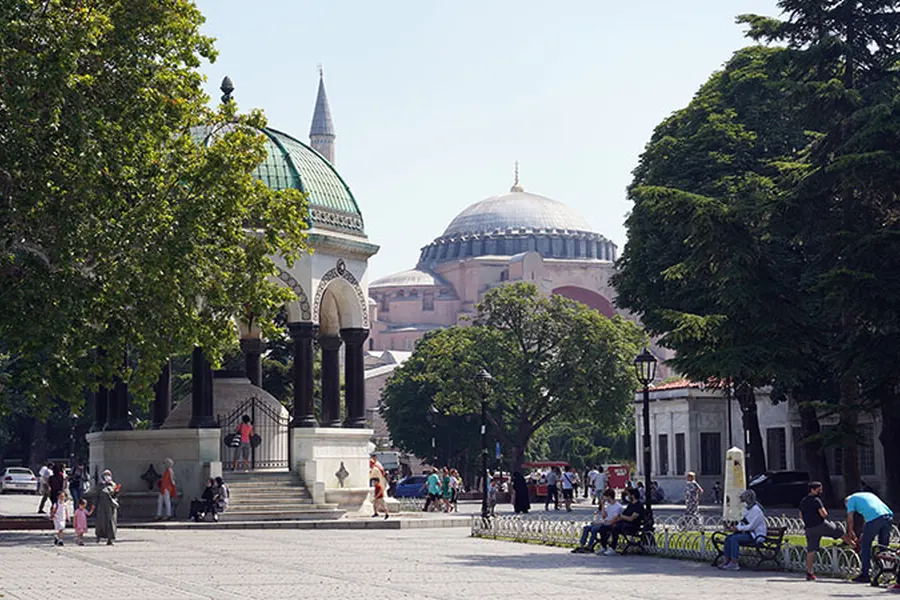
The German Fountain (Alman Çeşmesi) is an elegant domed fountain at the northern end of the Hippodrome in Sultanahmet. It was a gift from the German Emperor Kaiser Wilhelm II to Sultan Abdülhamid II and the city of Istanbul, a symbol of Ottoman-German friendship at the end of the nineteenth century.
Most visitors walk past it on the way between Hagia Sophia and the Blue Mosque. It is worth stopping for a few minutes to look inside the dome.

History of the German Fountain
Kaiser Wilhelm II visited Istanbul in 1898, his second visit to the Ottoman capital after a first trip in 1889, during a period of close political and economic ties between the two empires. The fountain was planned to commemorate that visit.
Germany was then one of the Ottoman Empire's closest partners. German engineers worked on the Anatolian and Baghdad railways, and the grand Haydarpaşa railway station on the Asian shore, completed in 1909, was designed by German architects. The fountain is a small but visible reminder of that era in the heart of the old city.
It was made in Germany, shipped to Istanbul in pieces and assembled on site. Its place on the Hippodrome, the most public square of the old city, made the Kaiser's gift highly visible. It was inaugurated in 1901, on 27 January, the Kaiser's birthday.
The bronze inscription on the fountain records, in German, that Wilhelm II built it in memory of his visit to Sultan Abdülhamid II in the autumn of 1898. There is an Ottoman Turkish inscription as well.
Architecture and details
The fountain is designed in a neo-Byzantine style, a nod to the history of the city. An octagonal pavilion with a dome rests on dark green marble columns, with taps for drinking water around the central basin.
- Look up inside the dome: it is covered in golden mosaics.
- Among the mosaics are the monogram of Abdülhamid II and the initial of Wilhelm II, set side by side.
- The carved marble, bronze work and stone details mix Byzantine, Ottoman and European motifs.

In some years, as part of Ramadan festivities, the fountain has been filled with sherbet (a sweet fruit drink) and served to the people of Istanbul, a revival of an old Ottoman custom.
What to see around the German Fountain
The fountain stands at the start of the ancient Hippodrome, so it is an easy first stop on a walk through Sultanahmet:
- The Sultanahmet Hippodrome, the Byzantine chariot-racing ground, now a long square.
- The Obelisk of Theodosius and the Serpent Column, a short walk south.
- The Blue Mosque, right next to the square, and Hagia Sophia a minute away.
- The İbrahim Pasha Palace across the square, home to the Museum of Turkish and Islamic Arts.
Tips for your visit
- Stand inside the pavilion and look straight up to see the mosaics properly; they catch the light best on a sunny day.
- Go early in the morning if you want photos without crowds, as the square fills up quickly with tour groups.
- Use the fountain as a meeting point: it is easy to find and sits between the main sights.
How to get to the German Fountain
Take the T1 tram to Sultanahmet. From the stop, walk towards the Blue Mosque; the fountain is at the northern end of the Hippodrome, between Hagia Sophia and the Blue Mosque. It is in a public square, so there is no ticket and you can see it at any time of day.
The fountain is included on many walks through the old city. Our guided Istanbul old city tour covers it together with the Hippodrome, the Blue Mosque and Hagia Sophia.
Frequently asked questions
Who built the German Fountain in Istanbul?
It was a gift from German Emperor Kaiser Wilhelm II to commemorate his 1898 visit to Sultan Abdülhamid II. It was made in Germany and assembled in Istanbul.
When was the German Fountain opened?
The fountain was inaugurated in 1901, on 27 January, Wilhelm II's birthday.
Where is the German Fountain?
It stands at the northern end of the Hippodrome in Sultanahmet, between Hagia Sophia and the Blue Mosque. The nearest tram stop is Sultanahmet on the T1 line.
Is there an entrance fee for the German Fountain?
No. The fountain is in a public square and you can see it at any time.
End your sightseeing day on the water
After the old city, see the palaces and mansions from the Bosphorus on a private sunset yacht cruise, only for your group.
More from our Istanbul guide
- Istanbul Archaeology Museums: History, Highlights and Visitor TipsIstanbul sights
- Basilica Cistern in Istanbul: History, Medusa Heads and Visitor TipsIstanbul sights
- Chora Church (Kariye Mosque) in Istanbul: History and Visitor GuideIstanbul sights
- Galata Tower in Istanbul: History, Legends and Visitor GuideIstanbul sights