
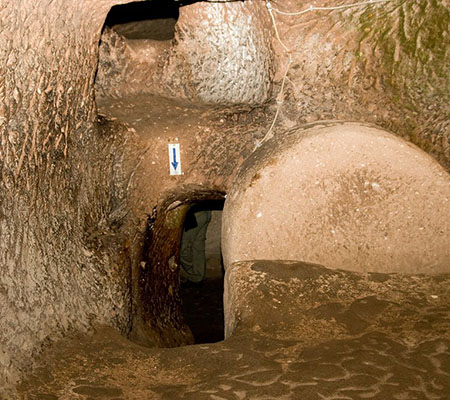
Özkonak Underground City has a different structure than the Kaymaklı and Derinkuyu Underground Cities in the region. Özkonak has very narrow and long holes for communication between floors. Those who lived at that time would have provided ventilation through these narrow holes when they closed the gates of the rooms against possible dangers.
Quick Facts
- Location: Özkonak town, Avanos district, Nevşehir Province, Cappadocia
- Distance from Avanos: approximately 14 km north
- Distance from Göreme: approximately 25 km
- Levels excavated: 10 (4 levels open to visitors)
- Estimated capacity: up to 60,000 people
- Discovered: 1972, by a local farmer named Latif Acar
- Site type: rock-cut subterranean settlement
History & Significance
Özkonak is one of the smaller and quieter underground cities of Cappadocia, but it offers an unusual look at the engineering that made these settlements possible. The site is carved into the soft volcanic tuff that covers much of the region, the same stone that allowed entire communities to dig homes, churches and storerooms beneath the surface. Most scholars trace the earliest tunnels here to the late Roman and early Byzantine periods, with extensive use during the 7th to 10th centuries when Arab raids pushed Christian communities to take shelter below ground.
Like Derinkuyu and Kaymaklı, Özkonak served as a refuge rather than a permanent home. Villagers lived above ground and retreated into the tunnels when danger approached, sometimes for weeks at a time. The complex includes living quarters, kitchens, wineries, stables, water wells and a chapel, all connected by narrow corridors that could be sealed with circular stone doors.
What sets Özkonak apart is its system of long, narrow vertical shafts that link the floors. Researchers believe these channels were used to communicate, to pour hot oil onto attackers who managed to breach the upper levels, and to maintain airflow when the heavy doors were rolled into place. The result is a defensive design that is more aggressive than the purely concealment-based layouts of some neighbouring cities.
The site was discovered in 1972 by a local farmer, Latif Acar, who noticed that water from his field was disappearing into a hole. Excavations revealed a network that archaeologists are still mapping today. Only a fraction of the city is open to the public, with research ongoing on the lower levels.
What to See
The open section of Özkonak is compact, which makes it manageable for visitors who feel claustrophobic in the larger underground sites. The route descends roughly 40 metres in places and takes around 30 to 45 minutes to walk through at a steady pace.
Highlights along the route include the circular millstone doors, each weighing several hundred kilograms, which could be rolled across corridor entrances to seal off whole floors. The communication shafts mentioned earlier are visible in several rooms, drilled cleanly through the rock between levels. There is a wine press carved directly into the tuff, a small chapel, ventilation chimneys that still draw air through the complex, and storage niches once used for grain and oil.
Look for the kitchen with its soot-blackened ceiling, the stable area with feeding troughs cut into the walls, and the cisterns that held the community’s water supply. Local guides often demonstrate how the stone doors were operated, which gives a good sense of the strength required and the ingenuity of the defensive system.
Visitor Information
Opening Hours
As of 2026, Özkonak Underground City is generally open daily. Summer hours (April to October) run approximately 08:00 to 19:00. Winter hours (November to March) run approximately 08:00 to 17:00. Hours can change without notice during religious holidays and bad weather, so check the official Ministry of Culture and Tourism site (muze.gov.tr) before your visit.
Tickets & Entry
Entry to Özkonak is significantly cheaper than the more famous underground cities. Approximate adult ticket prices as of 2026 are around 100–200 Turkish lira, though prices are updated annually. The Museum Pass Cappadocia and the broader MuseumPass Turkey both cover entry, which is worth considering if you plan to visit Göreme Open-Air Museum, Kaymaklı and other regional sites in the same trip.
How to Get There
Özkonak is easiest to reach by car or as part of an organised tour. From Istanbul, the standard route is a one-hour flight to Nevşehir Kapadokya Airport (NAV) or Kayseri Airport (ASR), followed by a transfer of about 45 to 60 minutes to Özkonak. From the main Cappadocia tourist hubs:
- Göreme: about 30 minutes by car, mostly via the Avanos road
- Avanos: about 15 minutes by car
- Ürgüp: about 35 minutes by car
- Nevşehir centre: about 25 minutes by car
Public buses (dolmuş) run between Avanos and Özkonak town but are infrequent. Most independent visitors hire a car or join a small-group tour that includes Özkonak alongside Avanos pottery workshops and the Paşabağ fairy chimneys.
Tips for Visitors
- Wear sturdy, closed-toe shoes — the floors are uneven and sometimes damp.
- Bring a light jacket. The temperature inside stays around 13–15°C all year, even when the surface is over 30°C in summer.
- If you are tall, expect to stoop in several corridors. Doorways were cut for people who were significantly shorter than the modern average.
- Visit early in the morning or after 15:00 to avoid coinciding with the larger tour buses that stop here in late morning.
- Anyone with claustrophobia or mobility limitations should choose a small underground site like Özkonak or skip this category altogether — passages can be tight.
- Photography is permitted, but a small torch helps. Many corners are deliberately dim.
- Toilets and a small refreshment stand are available at the entrance. There are no facilities inside the complex.
How Özkonak Compares to Other Underground Cities
Cappadocia has more than 200 known underground settlements, but only a handful are open to the public. Knowing how Özkonak fits into this group helps you decide whether to add it to your itinerary.
- Derinkuyu — the deepest at over 60 metres, 8 visitable levels, the largest visitor crowds. Best for travellers who want the headline experience.
- Kaymaklı — the broadest underground city, 4 visitable levels, slightly less demanding than Derinkuyu but still busy.
- Özkonak — smaller, much quieter, the only site with extensive communication and defensive shafts visible to visitors. Better for travellers who prefer a less crowded experience.
- Mazı — small village-style underground city near Mustafapaşa, very lightly visited, harder to reach without a car.
For visitors short on time, Özkonak makes the most sense as a complement to Derinkuyu or Kaymaklı, rather than as the only underground site you visit. The contrast between the headline scale of Derinkuyu and the engineering detail of Özkonak is genuinely useful for understanding the regional system.
Best Time to Visit
Cappadocia is a year-round destination, but each season has trade-offs for an Özkonak visit:
- Spring (April–May): mild surface temperatures, fewer tour buses, valleys covered in wildflowers. The constant underground temperature feels mild rather than cold.
- Summer (June–August): hot above ground (often 30–35°C), but the underground city is a welcome 14°C inside. Largest crowds; arrive early.
- Autumn (September–October): clear skies, golden light across the surface valleys, manageable crowds. Many travellers consider this the best window.
- Winter (November–March): the underground city stays at the same constant temperature, but the surface roads can be snowy. Hot-air balloon cancellations are common. Crowds are at a minimum.
Nearby Attractions
Özkonak pairs naturally with other sites in the northern Cappadocia loop. The Avanos pottery quarter, on the banks of the Kızılırmak (Red River), is about 15 minutes south and is a good lunch stop — many workshops offer hands-on pottery lessons in addition to selling finished pieces. The Paşabağ valley with its three-headed fairy chimneys is roughly 20 minutes away. Zelve Open-Air Museum, the abandoned cave village, sits next to Paşabağ and easily fills an afternoon. Devrent Valley (sometimes called Imagination Valley) is on the same route, with rock formations that resemble animals and figures. For visitors comparing underground cities, both Derinkuyu and Kaymaklı are around an hour to the south. Hacıbektaş, the centre of the Bektashi Sufi order, is around 30 km north and has a fine 13th-century complex for visitors with an interest in religious history.
How Long to Spend at Özkonak
The visitable section can be covered in 30 to 45 minutes at a relaxed pace. Most visitors combine it with the surrounding area:
- 30 minutes: a quick walk through the open levels, looking at the stone doors, the kitchen and the communication shafts.
- 60 minutes: a slower visit with time to ask the on-site guides questions, photograph the chambers and take in the engineering details.
- 90 minutes: includes a coffee or simple meal at one of the small cafés near the entrance, useful before continuing to Avanos or Paşabağ.
Avoiding the Crowds
Özkonak is much quieter than Derinkuyu and Kaymaklı because most coach tours stop at the larger sites. Even so, busloads do arrive — usually in late morning. To enjoy the site at its best:
- Arrive at opening (around 08:00) or after 15:00.
- Avoid Sundays and Turkish public holidays if you can — domestic tourism peaks then.
- Travelling outside the high summer season (June–August) generally means thinner crowds across all Cappadocian sites.
Plan Your Visit with Acetes Travel
Özkonak is best seen as part of a wider Cappadocia itinerary that combines underground sites, valley walks and a hot-air balloon flight. For visitors based in Istanbul, the most efficient way to see the region is our Cappadocia Tour from Istanbul, which includes return flights, hotel pickup and licensed local guides.