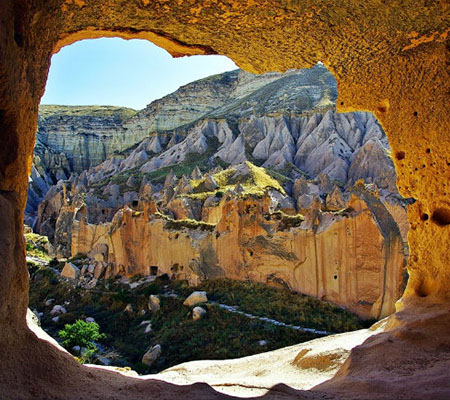
Like the Güvercinlik valley, the Zelve Valley, which hosts spectacular views, is particularly striking with its rock houses. Once you step here, you will be fascinated by the environment and you will be able to breathe the whole image and smell of history by imagining the people living in these rock houses a long time ago.
Zelve Valley is a must-see. Especially the caves and churches in the valley are among the places worth seeing.
Quick Facts
- Location: Zelve Open-Air Museum, Nevşehir Province, Cappadocia
- Distance from Göreme: approximately 10 km
- Distance from Avanos: approximately 5 km
- Distance from Paşabağ (Monks Valley): approximately 1 km
- Site type: three connected valleys with rock-cut dwellings and churches
- Status: UNESCO World Heritage Site (Göreme National Park and the Rock Sites of Cappadocia)
- Period of habitation: roughly 9th to mid-20th century AD
History & Significance
Zelve is one of the most complete examples of a true cave village in Cappadocia. The complex spreads across three adjoining valleys carved into soft volcanic tuff, with rooms, stables, churches and storage cellars cut into the cliff faces. Unlike the better-known Göreme Open-Air Museum, which focuses on Byzantine churches, Zelve preserves the texture of an everyday settlement, including a mosque, mill rooms, dovecotes and a few intact wine-pressing chambers.
The valleys were settled during the Byzantine period and served as a monastic and refuge community for Greek Christians for many centuries. The earliest churches date to the 9th and 10th centuries. After the Turkish conquest, Muslim and Christian populations lived alongside each other, and a small rock-cut mosque was added to the lower valley. The settlement continued into the modern era. In 1952, residents were relocated to the new village of Aktepe a few kilometres away because of erosion damage and the risk of rockfalls in the deteriorating tuff. The site was opened as an open-air museum in 1967.
The valley’s importance comes from its layered chronology — Byzantine, Seljuk, Ottoman and early Republican Turkish history all left traces on the same cliffs. Walking through Zelve gives a sense of how communities adapted continually to the rock around them, expanding old chambers, sealing collapsed ones and adding new ones over hundreds of years.
What to See
Zelve is organised as three valleys numbered 1, 2 and 3. Valley 1 has the best-preserved Christian rock-cut churches, including the Üzümlü Kilise (Grape Church) and the Geyikli Kilise (Deer Church), both with fragments of frescoes and incised crosses. Valley 2 contains the rock-cut mosque, one of the few examples of an Islamic prayer space carved directly into the tuff, complete with a mihrab and minbar. Valley 3 is less developed for visitors but offers panoramic viewpoints and quieter walking.
Specific features worth seeking out include the millstones and grain stores, the dovecotes high on the cliff faces (used to harvest pigeon droppings for fertiliser, a long Cappadocian tradition), and the deep wine-press rooms with carved channels that drained juice into collection basins. Look up at the rock surfaces and you will see soot-blackened ceilings from kitchens, niches that held oil lamps, and benches carved into living-room walls.
A short tunnel once connected Valleys 1 and 2 but is now closed due to instability. The current visitor route loops between the valleys via well-marked paths above ground. Allow 90 minutes to two hours to cover the full open-air museum at a relaxed pace.
Visitor Information
Opening Hours
As of 2026, Zelve Open-Air Museum is open daily. Summer hours (April to October) run approximately 08:00 to 19:00, with last entry around an hour before closing. Winter hours (November to March) run approximately 08:00 to 17:00. The site can close in heavy rain or snow because of the rockfall risk. Verify current hours via muze.gov.tr before your visit.
Tickets & Entry
Zelve has a separate ticket from Göreme Open-Air Museum, although both are operated by the Ministry of Culture and Tourism. Approximate adult entry as of 2026 is in the range of 200–400 Turkish lira; prices are revised annually. The MuseumPass Cappadocia covers entry to Zelve, Göreme, Paşabağ, the Kaymaklı and Derinkuyu underground cities, and the Mustafapaşa monastery, and usually represents good value if you plan two or more sites.
How to Get There
Zelve is on the Avanos road from Göreme, about 10 km north. Most visitors arrive by:
- Car or hire vehicle: 15 minutes from Göreme, 10 minutes from Avanos, 25 minutes from Ürgüp
- Organised tour: included on most North Cappadocia (Red) tour itineraries
- Bicycle or scooter: a popular option in good weather, with a paved road most of the way
- Walking: experienced hikers can reach Zelve from Göreme via the Çavuşin valley, which takes about two hours one way
From Istanbul, the standard approach is a one-hour flight to Nevşehir or Kayseri Airport followed by a transfer of around an hour. Most multi-day Cappadocia tours include Zelve as part of a wider northern itinerary that also takes in Paşabağ, Çavuşin and the pottery workshops of Avanos.
Tips for Visitors
- Wear sturdy shoes with good grip. The paths are uneven and some sections involve climbing into rock chambers via steel ladders.
- Bring a torch or use your phone light — many of the rock interiors are dark, even at midday.
- Carry water. There are no shops inside the site, only a small kiosk at the entrance.
- Visit Zelve and the neighbouring Paşabağ fairy chimneys together. They are 1 km apart and share an entry road, so the two combine naturally in one stop.
- Late afternoon light is excellent for photography across the cliffs, but bring a wide-angle lens to capture the full valley scale.
- If you have limited mobility, Zelve is more demanding than Göreme Open-Air Museum because of the rougher paths and ladder climbs. Plan accordingly.
- Avoid the midday tour bus arrivals (roughly 11:00–13:00) if you want quieter conditions inside the churches.
Zelve vs Göreme Open-Air Museum
Visitors with limited time often have to choose between Zelve and Göreme Open-Air Museum. They look similar on paper but serve different purposes:
- Göreme Open-Air Museum: focused, compact, dominated by Byzantine rock-cut churches with the best surviving frescoes in Cappadocia. The Karanlık Kilise (Dark Church) alone justifies the visit. Generally busy.
- Zelve Open-Air Museum: spread across three valleys, with a wider mix of secular and religious rock-cut spaces. Best for travellers who want to see a complete cave village, including domestic buildings.
If you can fit both in, do so — they cover different aspects of Cappadocian life. If you can only do one, choose Göreme for fresco quality, Zelve for atmosphere and village character.
Best Time to Visit
Each season offers a different feel for Zelve:
- Spring (April–May): wildflowers across the surrounding plain, comfortable hiking temperatures, balloon flights operating most mornings. A strong choice.
- Summer (June–August): hot above ground, but the rock interiors stay cool. Carry sun protection and water; the open valleys offer little shade.
- Autumn (September–October): warm days, cool evenings, golden light on the cliffs. Hot-air balloons usually fly daily.
- Winter (November–March): snow on the rocks is striking but the site can close briefly after heavy weather. Crowds are at their minimum.
Nearby Attractions
The northern Cappadocia loop is one of the most rewarding day routes in the region. From Zelve you can easily continue to Paşabağ fairy chimneys (also called Monks Valley) where the famous three-headed mushroom rocks rise from the plain. Devrent (Imagination) Valley sits a few kilometres further along the road, with rock formations that resemble animals and figures. Avanos, on the banks of the Kızılırmak (Red River), is the regional pottery centre and a natural lunch stop — the local clay tradition is several thousand years old and many workshops accept walk-in visitors. For a contrast in scale, the underground city of Özkonak is about 25 minutes north. Çavuşin village and church, on the road back to Göreme, is also worth a brief stop. Uçhisar Castle, the natural rock fortress dominating the western horizon, is about 20 minutes south and offers the best wide-angle view of the region’s geology.
Walking Routes Within Zelve
The three valleys are each worth visiting and connect by surface paths. Two suggested routes:
- Short loop (60–75 minutes): Valley 1 only, with stops at the Üzümlü Kilise, the Geyikli Kilise and the dovecote cliffs. Best for travellers with limited time.
- Full circuit (about 2 hours): all three valleys, including the rock-cut mosque in Valley 2 and the panoramic viewpoint at the top of Valley 3. Best for travellers who want a complete sense of the site.
Wear walking shoes. Some sections involve steel ladders, narrow passes and short scrambles. Bring water — there are no fountains inside the site.
Photography Tips
Zelve is one of the most photographable sites in Cappadocia, but the contrast between bright cliffs and dark cave interiors can challenge an exposure. Practical tips:
- Use a wide-angle lens or your phone’s wide setting for the valley overviews.
- Shoot interiors with a tripod or steady surface — the rock chambers are darker than they appear to the eye.
- Mid-afternoon light brings out the orange tones in the tuff; sunset lights the upper cliffs warmly.
- Avoid flash photography on any surviving frescoes — the pigments are sensitive to repeated light exposure.
Plan Your Visit with Acetes Travel
Zelve is best experienced as part of a longer Cappadocia stay rather than a rushed half-day. Our Cappadocia Tour from Istanbul includes flights, two nights on the ground and a guided North Cappadocia day that takes in Zelve, Paşabağ, Devrent and Avanos.