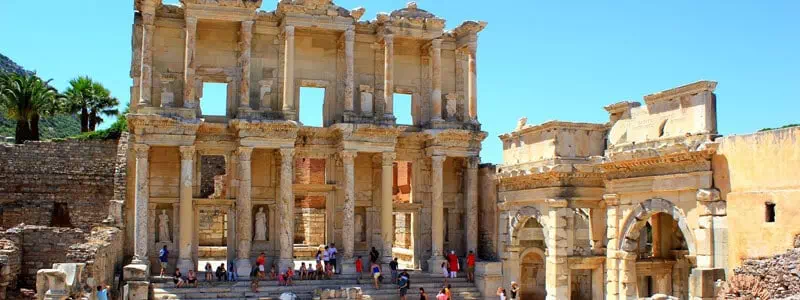
Currently situated in the delta where the Kucuk Menderes (Caystros) River reaches the Aegean Sea, Ephesus was moved a number of times due to natural causes. One of the leading centers and important ports of Antique lonia, the city was gradually pushed away from the sea by the fertile alluvial deposits , fully losing its port quality throughout the course of 2500 years after being pushed in by 9 km.
Up until 1990, the oldest finds in Ephesus belonged to the tombs in which Mycenaean objects were found, dating to 1400 B.C. The artifacts excavated from these are currently exhibited in the Hall of Grave artifacts. In the 1990s , during the excavations operated by the Ephesus Museum another Prehistoric settlement was discovered in Ayasuluk Hill , which dates back to the 300 B.C. New finds from excavations in Çukuriçi Mound in the southeast part of the city date the environs of Ephesus back to 8200B.C.But only for temporary settlements. In Çukuriçi Mound exhibit case in the museum are artifacts unearthed from this area.
Even though it dates further back, Ephesus lived its heyday in Hellenistic and Roman periods. The site visited today mostly date to these periods.
According to the myth, Ephesus was founded in the skirts of the Mount Panayır (Pion in Antiquity) by the legendary Androclus , son of codros ,the fabled king of Athens c. 1050 B.C. When Androclus decided to go over to Anatolia from the Greek Peninsula to start a new city, he went to see the Delphic oracle told him that the place to raise the city would be shown to him by a fish and wild boar. Androclus and his companions arrived at the Aegean shore, and as they were searing fish on the pan, a spark of the flames set the bush on fire. A wild boar hiding behind the bush was startled by the flames and started running, at the sight of which Androclus and his friends followed the boar; and remembering the oracle’s words, they built their new city at that spot! The originals of the Temple of Hadrian friezes narrating this myth in relief are exhibited in Ephesus Museum while the coppies are on display at the temple in the historic site.
Leaving myth aside, a group of immigrants from Attica to Anatolia actually came to the area and started to live side by side with the local people. The mentioned as Apasa in Hitite documents from 2000 B.C. was probably Ephesus. Carian, Lydian, and Lelegian Anatolian communities were the pre-lonian population of the city. Some Antique sources mention the Amazons as the founder of Apasa. While the original marble piece depicting an Amazons is in Vienna, a copy is exhibited in the Hall of Artemis Ephesia of the Selçuk Ephesus Museum.
Even though many names of Ephesus are mentioned along with Apasa, the name Ephesos(Ephesus) was the most widely known in history. Making it to Turkish as ‘Efes’. In the 7th century B.C. and in the first half of the 6th century B.C. Ephesians established good relations with the Lydians, until the attack of Kimmerians(650-625) B.C. a clan related with the Scythians; however there is no evidence for this incidence.
In the 560 B.C. ,the city was under the siege of Croesus , the king of Lydia. The King granted a major source of funding in order to build the Temple of Artemis, which would unite the peoples in the area. The temple, carrying on the mother goddess cult that prevailed in this land since ancient times, attracted people of belief from all around the world to Ephesus for years .The Temple of Artemis is known as one of the Seven Wonders of the World.
Ephesus, which would eventually be situated in the valley of Mount Panayır (Pion in Antiquity)and Mount Bülbül (Croessus in Antiquity) in the Hellenistic period where the site is today, encircled the temple from the second half of the 500B.C.to the early 300B.C. A majority of what remains from this edifice and its vicinity ,which provided immunity to all the people in its holy circle, is displayed in the Hall of Artemis Ephesia of the Ephesus Museum in the from of art objects and artifacts-along with a portian that is in the British Museum. The most valuable pieces in this hall, the two big Artemis statues have been found in the City Hall (Prytaneum) of the Antique Ephesus.
When King Croesus was defeated by the Persians in the west banks of Kızılırmak, like all of Lydian land, this land became to be dominated by the Persians in the 545 B.C.Ephesians joined the Delian League in the 479 B.C. and helped destroy the Athenian fleet by giving teir support to Spartans in the Peloponnesian Wars (431-404 B.C.) The city was re-dominated by the Persians in 386 B.C. and the situation was concluded with Alexander Great, King of Macedonia(reign 336-323 B .C.) defeating Persians and capturing Anatolia in 334 B.C. In 356 B.C., a mentally unstable person by the name of Herostratos burned the Temple of Artemis in the hopes of going down in history.
How much is Ephesus Antique City entrance fee?
The entrance fee of the city is 40 TL as of January 2018. Except for the entrance to Yamaç Evler and Ephesus Museum; Slope Houses are 20 TL, Efes Museum is 10 TL.
When is Ephesus Ancient City open?
Ancient City of Ephesus is open from April to October 08.00-19.00. Between November and March 08.00-17.00 hours open.
Where is Ephesus Ancient City?
Ancient city of Ephesus, Izmir, Selcuk, an ancient ruins of the town.
– 541 kilometers between Istanbul and central Ephesus, 6 hours and 20 minutes.
– Ankara, Ephesus 620 km 7 hours 20 minutes,
– 80 km 55 km away from the center of Izmir, Ephesus,
– Aydin, Ephesus between 130 km 2 hours and 10 minutes.
Plan Your Visit with Acetes Travel
Reading about Ephesus Information? See how Acetes Travel can make it part of your Istanbul itinerary — book direct, free cancellation, 24/7 WhatsApp support.
Explore the Ephesus Day Tour from Istanbul →