Ephesus Brothel Informations
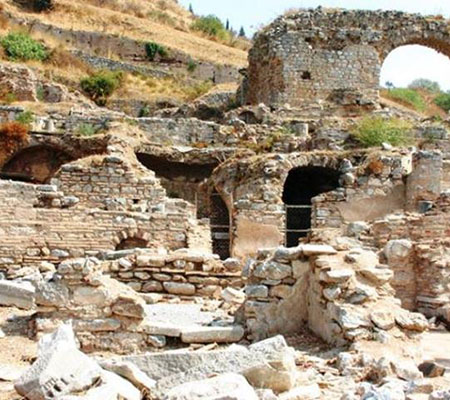
Building was called as Brithelbecause in the excavations, a statue of Priapus with an oversize phallus was found in the house. The statue is now presented in Ephesus Museum.
Brothel had two floors and rooms were on the first floor, even one room has a stone bed. Small rooms were built around a atrium, also building had a reception room which was decorated with a mosaic depiction four seasons; summer, spring, winter and fall.
Quick Facts
- Location: Curetes Street, opposite the Library of Celsus, Ephesus Archaeological Site
- Period: 1st century AD, with reconstruction in the 4th century
- Civilisation: Roman Imperial; later reused in Byzantine period
- Common names: Brothel of Ephesus, Love House, House of Pleasure
- Original use: subject of long scholarly debate (see below)
- Key find: Priapus statue, displayed at the Ephesus Archaeology Museum in Selçuk
History & Significance
The so-called Brothel of Ephesus sits at one of the most photographed corners of the ancient city, where Curetes Street meets the lane leading down to the Library of Celsus. The building is a two-storey Roman house with an inner courtyard, small adjoining rooms and an elaborate reception hall on the ground floor. The identification as a brothel rests primarily on a single find — a small statue of Priapus, the Roman fertility god usually shown with an exaggerated phallus, recovered during early 20th-century excavations and now on display at the Ephesus Archaeology Museum in Selçuk.
Modern archaeologists are divided. Some accept the brothel identification, citing the floor plan, the presence of a bathhouse next door, the small private rooms and the Priapus figure. Others argue that the building was a wealthy private residence and that the Priapus statue could just as easily have functioned as a household talisman or shop-front emblem. A few researchers suggest the structure may have served both purposes at different points in its long life — a private house, then a tavern with rooms upstairs, then perhaps converted to other uses in late antiquity.
Whichever interpretation is correct, the building offers a clear look at the construction techniques used in upper-class Roman houses of Asia Minor. The walls are made of opus mixtum — a combination of brick and stone — and the courtyards were paved with mosaics. The surviving Four Seasons mosaic in the main reception room is one of the most charming details on site.
Two further details often mentioned by guides deserve mention. First, an inscription nearby depicting a foot, a heart, a coin purse and a female figure has been described as the world’s oldest advertisement, supposedly pointing visitors toward the brothel. This reading is popular but not universally accepted by epigraphers; the symbols may simply be a directional inscription. Second, the building is connected by a tunnel to the Library of Celsus across the street. The tunnel exists, but archaeologists generally view it as part of the city’s drainage and service network rather than a discreet pathway between books and pleasure.
What to See
Visitors enter the building from Curetes Street and can walk through what remains of the ground floor. The courtyard is the centrepiece, with the Four Seasons mosaic still partly visible. Look for the seasonal figures around the border and the geometric panels that frame the central image.
The small rooms that line the courtyard are sometimes pointed out as the bedchambers. One of these contains a low stone platform that has been interpreted as a bed; whether the room was a bedroom, a workshop or storage is still debated.
The upper floor has not survived, but you can see where wooden joists once held it in place by looking at the rectangular sockets in the walls. The neighbouring Scholastikia Baths, named after the Christian patroness Scholastikia who is believed to have funded its 4th-century restoration, are connected to the brothel by a corridor — another piece of evidence cited in the brothel theory, as bathhouses and brothels often shared infrastructure in Roman cities.
Visitor Information
Opening Hours
The Brothel of Ephesus is part of the main Ephesus Archaeological Site. As of 2026, summer hours (April to October) run approximately 08:00 to 19:00 with last entry around an hour before closing. Winter hours (November to March) run approximately 08:30 to 17:00. Hours can shift around public holidays — check muze.gov.tr for the latest information.
Tickets & Entry
Entry is included in the general Ephesus Archaeological Site ticket. As of 2026, the standard adult ticket is approximately 40 euros equivalent; prices are revised annually. The Terrace Houses just up the slope require a separate supplementary ticket, which is worth buying together if you have the time. MuseumPass Aegean and MuseumPass Turkey both cover Ephesus.
How to Get There
Ephesus is located near Selçuk in İzmir Province, on Turkey’s Aegean coast. From Istanbul, the easiest route is a one-hour flight to İzmir Adnan Menderes Airport (ADB), followed by a 45-minute drive south to Selçuk. From Kuşadası, Ephesus is a 20-minute drive. From the site’s Upper Gate, walk downhill along Curetes Street — the brothel is on your right, just before you reach the Library of Celsus. Coming from the Lower Gate, the brothel is on your left, immediately after the Library.
Tips for Visitors
- The site is open-air and largely unshaded. Bring a hat, sunscreen and at least one litre of water per person in summer.
- Photography is permitted but the surviving mosaic is fenced off to prevent footfall damage. Step around the marked perimeter.
- Stop at the inscription with the foot, heart, coin and female figure on the marble pavement opposite the building before you go in — it adds context to the visit.
- The connecting passage to the Scholastikia Baths is worth a brief look. Visitors often miss it because the path is short.
- Reading the Priapus statue’s history at the Ephesus Archaeology Museum after the site visit makes the on-site experience more meaningful.
- Children may find the topic awkward. Most guides handle the discussion sensibly; if you are travelling with younger family members, mention this to your guide in advance.
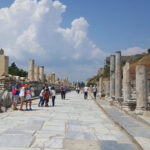
- The pavement of Curetes Street is polished marble. Wear shoes with grip, especially in winter when light rain leaves the surface very slippery.
The Famous “Advertisement” Inscription
Across the marble pavement of Curetes Street, opposite the entrance to the building, an incised inscription shows several figures: a left foot, a heart, a coin purse and the silhouette of a woman. For decades, tour guides have described this as the world’s oldest commercial advertisement, supposedly directing customers toward the brothel.
The reality is less certain. Most epigraphers read the symbols as a simple directional inscription, possibly indicating the entry to a building or the next major shop along the street. The “advertisement” interpretation gained popularity in the early 20th century and has stuck in the popular imagination. Whatever its true purpose, the inscription is one of the few pieces of street-level graphic communication that survives anywhere in the Roman world, and that alone makes it worth pausing to see.
Connection to the Library of Celsus
A frequently repeated story claims that a secret tunnel connected the Library of Celsus to the brothel, allowing wealthy Ephesians to slip discreetly from one to the other. The tunnel exists — it has been mapped — but most archaeologists view it as part of the city’s drainage and service network rather than a discreet passageway. Roman cities routinely had underground service tunnels for water, sewage and goods delivery, and these passed beneath many important buildings.
The story persists because it makes such a good tour anecdote. Like several other popular tales about the building (including the literacy test some guides claim was administered to visitors), it should be taken as folklore rather than verified history.
Best Time to Visit
Ephesus is open year-round. For the brothel specifically, the early-morning slot is best — the building is at one of the busiest corners of the site, and tour groups often spend several minutes here.
- Spring (April–May): comfortable temperatures, wildflowers, manageable crowds. Often the best window.
- Summer (June–August): hot and very busy with cruise traffic. Arrive at opening or visit in the last 90 minutes before close.
- Autumn (September–October): clear skies, fewer cruise visitors, warm days.
- Winter (November–March): cool and quiet, but the marble is slippery when wet.
Nearby Attractions
The brothel sits at the heart of Ephesus, surrounded by major monuments. Directly opposite is the Library of Celsus, one of the most famous façades in the ancient world. Just up Curetes Street is the Temple of Hadrian, the Trajan Fountain and the Terrace Houses. Below the Library is the Mazaeus and Mithridates Gate and the Lower Agora. Further along the marble road is the Great Theatre with seating for 25,000. Outside the archaeological site, the Ephesus Archaeology Museum in Selçuk holds the Priapus statue and many of the small finds from the building. The Basilica of St John and the surviving column of the Temple of Artemis are also in Selçuk, and the village of Şirince is 15 minutes away by road.
Plan Your Visit with Acetes Travel
The Brothel of Ephesus comes alive when you can walk it with a guide who can separate the verified history from the popular story. Our Ephesus Tour from Istanbul covers all the major buildings along Curetes Street with a licensed guide, plus return flights and transfers.