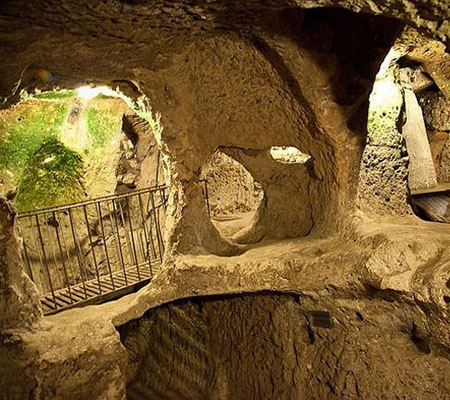
Derinkuyu Underground City, located in the Derinkuyu district of Nevşehir, is the widest underground city in the region. Derinkuyu, one of the underground cities which is thought to have been constructed since Protohitit period, can be visited eight times today.
In the open areas of the underground city, there are stables, cellar, dining hall, church, winery, school of missionaries, study rooms, sleeping and resting units and burial chambers.
Quick Facts
- Location: Derinkuyu town, Nevşehir Province, Cappadocia
- Distance from Nevşehir centre: approximately 30 km south
- Distance from Göreme: approximately 40 km
- Levels excavated: at least 18, with 8 levels open to the public
- Maximum depth open to visitors: approximately 60 metres
- Estimated capacity: around 20,000 people, plus livestock and provisions
- Status: UNESCO World Heritage Site as part of the Göreme National Park and Rock Sites of Cappadocia
- Rediscovery: 1963, by a local resident expanding his home
History & Significance
Derinkuyu is the deepest and one of the largest of the more than 200 underground settlements identified across Cappadocia. The earliest construction dates are debated. Some scholars trace the first chambers to the Phrygian period in the 8th–7th centuries BC. Others argue for a later start under early Christian communities. What is clear is that the city expanded significantly between the 5th and 10th centuries AD as a refuge for Christian populations during periods of Arab and Sassanid raids, and again during the Byzantine-Arab wars.
The complex is organised around a central ventilation shaft that drops roughly 55 metres through the rock and connects to dozens of smaller air channels. Heavy circular stone doors, weighing up to half a tonne, could be rolled across the corridors to seal off entire floors. The doors were designed to be opened only from the inside — once closed, they were extremely difficult for attackers to move.
The lower levels held storage rooms, wineries, oil-pressing chambers and water cisterns. Some cisterns were deliberately separated from the rest of the network so that they could not be poisoned from above. Higher levels held living quarters, stables and a missionary school whose vaulted ceiling and barrel-arched ceiling are still preserved. There is a small cruciform church and several baptismal fonts that confirm the strong Christian use of the site.
Derinkuyu is connected to Kaymaklı, another large underground city about 9 km north, by a long tunnel. Sections of this tunnel have been mapped but it is not currently open to the public for safety reasons. The existence of the connection underlines how Cappadocia’s underground network was less a series of isolated bunkers and more a regional system of refuges.
The site was rediscovered in 1963 when a local resident, demolishing a wall in his home, broke through into one of the upper chambers. Excavation and stabilisation works continue today.
What to See
The visitor route loops through 8 of the 18 known levels. From the entrance, you descend through narrow passageways into a sequence of chambers connected by stairs and inclined tunnels. The route is marked with arrows for downward traffic on one side and upward traffic on the other to manage crowding.
Key features along the route include:
- The stable area on the upper level, with feeding troughs cut into the rock
- The wine and oil presses, with channels carved to drain liquid into collection basins
- The communal kitchen with a soot-blackened ceiling and chimney
- The missionary school with its arched ceiling and rows of small alcoves
- The cruciform church, located on a lower level
- Water wells and a deep cistern, located near the central ventilation shaft
- The circular stone doors, several of which can be seen in their original position
- The temporary tomb chambers used to hold the dead until the refuge was safe to leave
Allow 60 to 90 minutes for a relaxed visit. The descent is roughly 60 metres total.
Visitor Information
Opening Hours
As of 2026, Derinkuyu Underground City is open daily. Summer hours (April to October) run approximately 08:00 to 19:00. Winter hours (November to March) run approximately 08:00 to 17:00. The last admission is typically one hour before closing. The site can close briefly in heavy weather; check muze.gov.tr before travelling.
Tickets & Entry
Approximate adult ticket prices as of 2026 are around 400–600 Turkish lira; prices are revised annually. The MuseumPass Cappadocia and MuseumPass Turkey both include Derinkuyu and usually pay for themselves if you also plan to visit Göreme Open-Air Museum, Zelve, Paşabağ and Kaymaklı in the same trip.
How to Get There
Derinkuyu town sits on the main road south of Nevşehir. From Istanbul, the standard approach is a one-hour flight to Nevşehir Kapadokya Airport (NAV) or Kayseri Airport (ASR), followed by a transfer. Driving times from regional hubs:
- Nevşehir centre: approximately 35 minutes south
- Göreme: approximately 45 minutes
- Ürgüp: approximately 40 minutes
- Kaymaklı: approximately 10 minutes north
Public buses (dolmuş) run between Nevşehir and Derinkuyu town; the underground city entrance is a short walk from the bus stop. Most multi-day tours of Cappadocia include Derinkuyu (or Kaymaklı) as part of the Green Tour route, which also covers the Ihlara Valley and Selime Monastery.
Tips for Visitors
- Wear sturdy, closed-toe shoes with grip. The floors are uneven and some passages are damp.
- Bring a light jacket. The temperature inside stays around 13–15°C all year, even when the surface is well above 30°C in summer.
- Anyone with claustrophobia should consider a shorter underground site like Özkonak instead, or skip the underground sites altogether. Several corridors are narrow and require crouching.
- Visitors with significant back, knee or heart conditions should think carefully before descending. The route is physically demanding and the only way out is the way back up.
- Bring a small torch or use your phone light to spot details in dimly lit chambers.
- Visit in the morning, soon after opening, to avoid the midday tour bus arrivals. By 11:00 the queues at the narrow corridors can slow movement significantly.
- There are no toilets inside the complex. Use the facilities at the entrance before you descend.
- Photography is permitted. A wide-angle lens is helpful in the larger chambers; the narrower corridors are difficult to capture.
Derinkuyu vs Kaymaklı: Which Should You Visit?
Most visitors only see one of the two big Cappadocian underground cities. The choice often comes down to the day’s tour schedule, but each has distinct strengths:
- Derinkuyu: deeper (60+ metres open to visitors), more vertical, more imposing scale, with the central ventilation shaft as the dominant feature. The visitor route descends through multiple distinct levels.
- Kaymaklı: broader (the largest known underground city by horizontal area), more horizontal, with bigger communal rooms on the upper levels. The visitor route is less steep and somewhat more accessible.
If you have time for both, visit them together — they are only 9 km apart. If you can only do one, choose Derinkuyu for vertical drama, Kaymaklı for a less physically demanding visit. Visitors with mild claustrophobia generally cope better with Kaymaklı.
How the Cities Worked Day to Day
It is easy to read about underground cities and picture them as full-time settlements. They were not. Villagers lived above ground and farmed the surrounding land. The underground complex was a refuge, used in emergencies — Arab raids, Persian incursions, brigand attacks — for stays that ranged from a few days to several weeks. Provisions were brought down in advance: grain, oil, wine, dried fruit, salted meat.
Inside the refuge, daily routines balanced practical work and survival. The wineries continued to produce, because grapes had been brought below ground before sealing. The schools and chapels operated as they would have above. Cooking was confined to specific levels to manage smoke and reduce the risk of detection. Stables on the upper levels held livestock, with feed dropped down chutes from the surface.
Water management was the most critical element. Cisterns were carved deep into the rock and isolated from outside groundwater so that the supply could not be poisoned. Some wells reached over 80 metres into the bedrock to ensure year-round access.
Best Time to Visit
- Spring (April–May): mild surface temperatures, fewer tour buses, comfortable underground stays.
- Summer (June–August): hot above ground but a constant 14°C inside the city — a welcome break from the heat. Largest crowds; visit early.
- Autumn (September–October): clear skies above, manageable crowds below.
- Winter (November–March): snow may close the surface roads briefly, but the underground city itself is unaffected. Visitor numbers are minimal.
Nearby Attractions
The Green Tour route across southern Cappadocia naturally combines Derinkuyu with the Ihlara Valley, the Selime Monastery and the Pigeon Valley viewpoint near Uçhisar. The Kaymaklı Underground City is just 9 km north and provides an interesting comparison — broader in plan but shallower than Derinkuyu. For visitors curious about smaller, less crowded examples, Özkonak is about an hour north. Above ground, the open-air museums at Göreme and Zelve are about 45 minutes away and complete the picture of Cappadocia’s Byzantine and early Christian heritage. The town of Ürgüp, with its boutique cave hotels and a strong local food scene, is a good base for visitors planning multiple days in the region.
Plan Your Visit with Acetes Travel
Derinkuyu is one of the most striking underground spaces in the world, and a good guide turns the visit into a story rather than a corridor walk. Our Cappadocia Tour from Istanbul includes return flights, hotel pickup and a guided day across the southern circuit, with Derinkuyu (or Kaymaklı, depending on the day’s schedule) as a centrepiece.