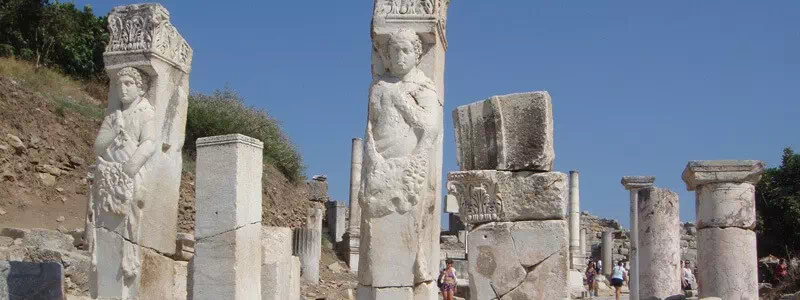
The door of Hercules. This is the most beautiful photo point of Ephesus. The door of Hercules is a gate with two columns. Hercules mad with god chief Zeus’ Hera and then killed his wife and child wanted to chop his own soul, but his friends had stopped.
This door would separate the religious and social parts of the city and was constantly protected by two guards. The delegates would check the identity of the citizens who wanted to enter and send the cleaners to the bathhouse. This door is said to have been made here in the 4th century.
Quick Facts
- Location: Upper section of Curetes Street, between the State Agora and the Temple of Trajan, Ephesus Archaeological Site
- Construction date of the relief panels: 2nd century AD
- Reassembled at current location: late 4th or early 5th century AD
- Civilisation: Roman, reused in late Roman / early Byzantine period
- Surviving elements: two relief panels showing Hercules wearing the Nemean lion’s skin
- Original location: probably elsewhere in the city, dismantled and reused here as a narrow gate
History & Significance
The Gate of Hercules is a small but instantly recognisable monument that visitors pass on the way down Curetes Street. It is named for the two carved panels that flank it, each depicting the hero Hercules draped in the skin of the Nemean lion. The lion’s head sits on top of Hercules’ own, and the lion’s paws are knotted across his chest — a standard iconography in Roman art that signals the first of Hercules’ twelve labours.
The panels are older than the gate itself. They were carved in the 2nd century AD as part of an earlier monument, possibly a triumphal arch or a public building in another part of the city. In the late 4th or early 5th century AD, during the late Roman and early Byzantine period, the panels were dismantled from their original setting and reused here, set into a narrow passageway that restricted Curetes Street to pedestrian traffic. Carts and chariots could no longer pass beyond this point.
The reuse of older sculpture in late antique architecture is a well-documented practice known as spolia. At Ephesus the practice is especially visible because so many monuments were reworked during the city’s slow decline. The Gate of Hercules also served a practical urban function — narrowing the street allowed the authorities to control who came and went between the lower commercial district and the upper civic area around the State Agora and the prytaneion. Some commentators have suggested the gate was guarded, but the historical evidence for permanent guards at this specific location is thin.
The mythological reference is appropriate to the location. Hercules in Greco-Roman culture was associated with protection, strength and the boundary between human and divine, all qualities suitable for a city gate. The hero’s many adventures, including the legend that he went temporarily mad under the influence of Hera and harmed his own family before being purified through the twelve labours, made him a complex symbol of human striving — and a frequent decorative motif on monuments that marked transitions in city space.
What to See
The two surviving relief panels stand on either side of the narrow passageway. Get close enough to see the detail in the carving: the lion’s claws across Hercules’ chest, the muscular treatment of the torso, and the slight forward stance of the figures. The carving is high-relief, almost free-standing in places, and the figures lean slightly toward each other across the gate.
Above the gate, fragments of the original cornice and architrave have been reset on top of the columns. These do not all belong to the original monument and were reassembled during 20th-century conservation work. The Greek-style Corinthian capitals and the surviving decorative blocks give a sense of how the gate would have looked in its final late-Roman form.
Stand back from the gate and look up Curetes Street toward the State Agora — the framing makes for a striking photograph, particularly in early morning light. From the same spot, looking the other way, the gate frames a downhill view toward the Trajan Fountain, the Temple of Hadrian and ultimately the Library of Celsus in the distance.
Visitor Information
Opening Hours
The Gate of Hercules is part of the Ephesus Archaeological Site and is included in any visit. As of 2026, summer hours (April to October) are approximately 08:00 to 19:00, with last entry around an hour before closing. Winter hours (November to March) are approximately 08:30 to 17:00. The site closes on a small number of public holidays. Check muze.gov.tr for current information.
Tickets & Entry
The Gate of Hercules is covered by the general Ephesus ticket. As of 2026, the standard adult entry fee is approximately 40 euros equivalent; this is updated annually. The Terrace Houses, slightly below the gate on the slope, require a separate supplementary ticket. MuseumPass Aegean and MuseumPass Turkey both include Ephesus and are good value if you are visiting multiple sites.
How to Get There
Ephesus is near Selçuk in İzmir Province. From Istanbul, fly to İzmir Adnan Menderes Airport (ADB) and drive south for about 45 minutes. From Kuşadası, the site is 20 minutes by road. The Gate of Hercules sits in the upper third of Curetes Street, so the easiest approach is via the Upper Gate (Magnesia Gate) — walk a short distance past the State Agora and Domitian Square and you will reach the gate within five minutes. From the Lower Gate, the gate is about 25 to 30 minutes uphill past the Library of Celsus and the Temple of Hadrian.
Tips for Visitors
- For the cleanest photographs, arrive within the first 30 minutes after opening. The narrow gate channels visitor traffic, and queues build through the morning.
- Take pictures from both sides of the gate. The downhill view toward the Library of Celsus is particularly popular.
- Look closely at the column shafts and capitals as well as the Hercules panels. The mix of older and reused stone is one of the gate’s most interesting features.
- The path through the gate is narrow. Visitors with wheelchairs or pushchairs can usually pass, but it can be tight in peak hours.
- The gate is unshaded and sits on a slope. Take care with footing on the polished marble, especially in damp weather.
- A licensed guide is invaluable here — many of the small details about reused sculpture and late antique urbanism are not signposted.
- Combine your visit with the Trajan Fountain immediately downhill, where you can see another good example of reused architectural elements.
Spolia in Late Antique Ephesus
The reuse of older sculpture and architectural elements in late antique building is one of the most distinctive features of Ephesus’ final centuries as a major city. The Gate of Hercules is a clear example, but it is not the only one. Walking the site with an eye for spolia adds a useful layer to any visit.
- Many of the columns along Curetes Street were originally cut for other buildings and reset here in late Roman repaving phases.
- The Memmius Monument, just up the street from the Gate of Hercules, was modified several times across the Roman period.
- The 4th-century AD restoration of the Scholastikia Baths reused architectural elements from older structures.
- Christian basilicas built in the 5th and 6th centuries across the city incorporated pagan-era columns, capitals and architraves.
This pattern reflects both economic constraints — fresh marble cutting was expensive — and shifting aesthetics that valued antique elements as markers of continuity with the city’s classical past.
The Mythology of Hercules in Roman Asia Minor
Hercules was an unusually popular figure in Roman Asia Minor, partly because his legendary travels through the region connected local sites to Greek mythology. The hero was credited with founding several cities, defeating regional monsters and visiting Anatolian kingdoms. Carvings of Hercules wearing the Nemean lion’s skin appear on city gates, sarcophagi, public buildings and household objects across the province of Asia. The choice of Hercules for an Ephesian gate signal both the universal appeal of the figure and the city’s deep engagement with classical Greek heritage.
Best Time to Visit
The gate is a major photo stop, so timing matters:
- Spring (April–May): clear skies, comfortable temperatures, fewer cruise groups. The wildflowers along Curetes Street add foreground colour.
- Summer (June–August): hot and very busy. Aim to be at the gate within 30 minutes of opening for clean photos.
- Autumn (September–October): warm days, clear light, manageable crowds.
- Winter (November–March): cool and quiet. Marble paving is slippery when damp.
Nearby Attractions
The Gate of Hercules sits in the centre of Ephesus’ most photogenic stretch. Uphill you have the Memmius Monument, the Pollio Fountain, the Temple of Domitian and the State Agora. Downhill, in walking order, you pass the Trajan Fountain, the Temple of Hadrian, the Ephesus Latrine, the Scholastikia Baths, the Terrace Houses, the Library of Celsus, the Brothel of Ephesus and finally the Great Theatre. In Selçuk, the Ephesus Archaeology Museum displays the smaller finds. The Basilica of St John, the Isa Bey Mosque, the remaining column of the Temple of Artemis and the House of the Virgin Mary complete the standard Ephesus circuit.
Plan Your Visit with Acetes Travel
Ephesus is one of those sites where the spolia, the inscriptions and the layered phases of construction reward a guided visit. Our Ephesus Tour from Istanbul covers return flights, transfers and a licensed local guide who can point out details like the reused Hercules panels.