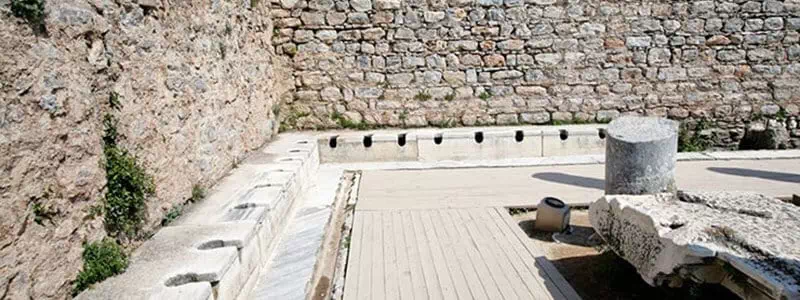
The latrine, located on the arcade that runs on a north-south axis between the Scholastikia Baths and the Temple of Hadrian, always attracts interest. The door on the east side opens onto the Street. This public toilet has square basin in the middle, and rows of toilet seats along the sides. A channel of water ran directly in front of the seats.
Mosaics decorated the floor of the latrine. In antiquity, only the part of the latrine containing the toilet seats was covered. Four columns at the corners of the water basin carried the roof.
Quick Facts
- Location: Curetes Street, beside the Scholastikia Baths, Ephesus Archaeological Site
- Period: 1st century AD construction, with later restorations into the Byzantine period
- Civilisation: Roman Imperial
- Type: communal public latrine (foricae)
- Capacity: approximately 36–48 seats around three sides of a rectangular courtyard
- Original drainage: continuous flow connected to the main city sewer beneath Curetes Street
History & Significance
The Ephesus Latrine is one of the best-preserved examples of a Roman public toilet anywhere in the empire. It is a single rectangular hall lined with stone seating along three walls, with a continuous trough of running water in front of the seats for washing. A second water channel beneath the seats carried waste out to the city’s sewer system beneath the marble paving of Curetes Street.
Public latrines were a standard feature of Roman city life. They were not, by modern standards, particularly private — users sat side by side, often continuing conversations or business meetings, and the space was lit by an open central courtyard. Visiting the latrine could be a social act, especially for the wealthier classes who used the adjoining Scholastikia Baths and stopped at the latrine on their way in or out.
The latrine at Ephesus is often described as having required a small entry fee. Whether this applied to everyone or only to certain users is unclear from the surviving sources. What is well-attested across the Roman empire is that the use of public toilets was supported by taxes on the urine collected from them — the famous saying pecunia non olet (money does not stink) is reportedly Emperor Vespasian’s defence of this tax. The urine had economic value because fullers used it as a source of ammonia to clean and bleach wool.
The latrine sits in one of the busiest parts of the city, on the slope between the Temple of Hadrian and the Library of Celsus. Its location made it a convenient stop for shoppers, market-goers and visitors to the nearby baths. Visitors today often laugh when they hear that the marble seats were heated in winter — wealthy citizens reportedly sent slaves ahead to sit on the cold stone and warm it before their masters arrived.
What to See
The main hall is the central attraction. Stone seats with the characteristic keyhole-shaped openings line three of the four walls. Walk around the perimeter to see the water channel that runs in front of the seats — this is the channel users dipped a sponge on a stick (the tersorium) into for personal hygiene. The central courtyard would have been open to the sky, which provided light and ventilation.
Look for the remains of the mosaic floor in the surviving sections, and for the marble facings on the lower walls. The four supporting columns that once held the roof above the seated area are no longer present, but the column bases are still visible at the corners of the central pool. The pool itself collected rainwater from the open courtyard and helped flush the system.
From the latrine, you can step directly through into the Scholastikia Baths next door. The proximity is not accidental — Roman bath complexes routinely included a latrine block as standard infrastructure.
Visitor Information
Opening Hours
The Ephesus Latrine is part of the Ephesus Archaeological Site and is included in the standard site visit. As of 2026, summer hours (April to October) run approximately 08:00 to 19:00, with last entry around 18:00. Winter hours (November to March) are approximately 08:30 to 17:00. Always check muze.gov.tr before travelling, as hours change with daylight savings and around public holidays.
Tickets & Entry
The latrine is covered by the standard Ephesus ticket; no additional payment is required. As of 2026, adult entry to the site is approximately 40 euros equivalent. The MuseumPass Turkey and MuseumPass Aegean both include Ephesus. The Terrace Houses, immediately above the latrine on the slope, require a separate supplementary ticket and are well worth combining with this visit.
How to Get There
Ephesus is in İzmir Province on Turkey’s Aegean coast, near the town of Selçuk. From Istanbul, fly to İzmir Adnan Menderes Airport (ADB), then drive 45 minutes south to the site. From Kuşadası, Ephesus is about 20 minutes by road. From the Upper Gate (Magnesia Gate), walk down Curetes Street; the latrine is on your right just below the Temple of Hadrian. From the Lower Gate, walk up past the Library of Celsus; the latrine is roughly halfway between the Library and the Temple of Hadrian on the left.
Tips for Visitors
- This is one of the smaller stops along Curetes Street, but it draws a steady stream of visitors who want to sit on the seats for a photo. Be patient — most guides keep their groups moving quickly.
- Try to spot the keyhole-shape openings on the stone seats. The narrow front section was for the sponge stick.
- Look up at the column bases at the corners of the central pool, and look down at the surviving mosaic fragments at your feet.
- Combine the latrine with the Scholastikia Baths next door for a clearer picture of Roman hygiene infrastructure.
- The site is open-air and unshaded. Wear sun protection in summer and bring a waterproof in winter.
- Wheelchair users will find the latrine accessible from Curetes Street, but the slope of the street itself is steep — take this into account when planning the route through Ephesus.
- Photography is straightforward; a wide-angle lens helps you frame the full ring of seats.
Roman Hygiene Practices Explained
The Ephesus latrine is more than a curiosity — it preserves a useful record of how Roman cities approached public sanitation. Several aspects are worth understanding:
- The tersorium: a sponge tied to a wooden stick, used for personal cleaning. The stick was rinsed in the water channel between uses. This is the origin of the Latin phrase “to get the wrong end of the stick”.
- Communal water source: the trough in front of the seats served both washing and rinsing. Modern sensibilities find this surprising, but most Roman urban hygiene operated on continuous-flow principles.
- Aqueducts and drainage: latrines worked because they were connected to a citywide water supply (via the aqueduct) and a sewer system. Cities without this infrastructure could not maintain public latrines on this scale.
- Privacy norms: Romans did not view shared latrine use as inherently private. It was a normal social space, and inscriptions from other sites show that polite phrases of greeting were expected on entry.
- Maintenance: latrines were cleaned daily, often by slave labour. The collected waste went directly to the sewer; the urine, in some cities, was collected separately for industrial use.
The Vespasian Tax on Urine
Most visitors hear the story about Emperor Vespasian’s urine tax at some point during their Ephesus visit. The story is true. Roman fullers (textile cleaners) used aged urine as a source of ammonia for cleaning wool. Public latrines collected urine in jars, and Vespasian imposed a tax on this trade. When his son Titus complained that the tax was undignified, Vespasian held up a coin and asked whether it smelt. The phrase pecunia non olet — money does not stink — is still in use today.
Best Time to Visit
The latrine is along the busiest stretch of Curetes Street, so timing matters:
- Spring (April–May): comfortable temperatures, low cruise traffic. Often the best window.
- Summer (June–August): very hot and busy. Arrive at opening for the cleanest experience.
- Autumn (September–October): warm days, clear light, manageable crowds.
- Winter (November–March): cool, occasionally wet, and very quiet. Marble paving is slippery when damp.
Nearby Attractions
The latrine sits at the centre of the most monumental stretch of Ephesus. The Scholastikia Baths are immediately next door, the Temple of Hadrian stands directly across Curetes Street, and the Terrace Houses climb the slope above. Just downhill is the Library of Celsus, opposite the building popularly known as the Brothel of Ephesus. Continuing down Curetes Street takes you to the Lower Agora and the Great Theatre. In Selçuk, the Ephesus Archaeology Museum displays many of the smaller objects recovered from the site, including surgical instruments and household items that show how Romans approached personal care more broadly. The Basilica of St John and the surviving column of the Temple of Artemis are also in Selçuk.
Plan Your Visit with Acetes Travel
The everyday details of Roman city life — toilets, taverns, bath schedules — often bring Ephesus to life more vividly than the temples. Our Ephesus Tour from Istanbul includes return flights, all transfers and a licensed guide who can explain what you are looking at, including the practical wonders like the latrine.